
Duro Ladipo: The Theatre Maker Who Put Yoruba Myth on Stage
By: Yvonne Mag-usara
Long before Yoruba stories reached television screens or international theatre festivals, Duro Ladipo was building entire worlds from drums, chants, movement, and spoken Yoruba.
Rather than treating oral tradition as material that needed to be translated into a European theatrical form, Ladipo made its rhythms part of the theatre itself. Kings entered with praise poetry. Drums carried meaning. Sacred stories became live drama.
His best-known work, Ọba kò so, brought the story of Ṣàngó from Yoruba historical and religious tradition onto the stage and eventually before international audiences. Smithsonian collections still preserve recordings and documentation of the production.
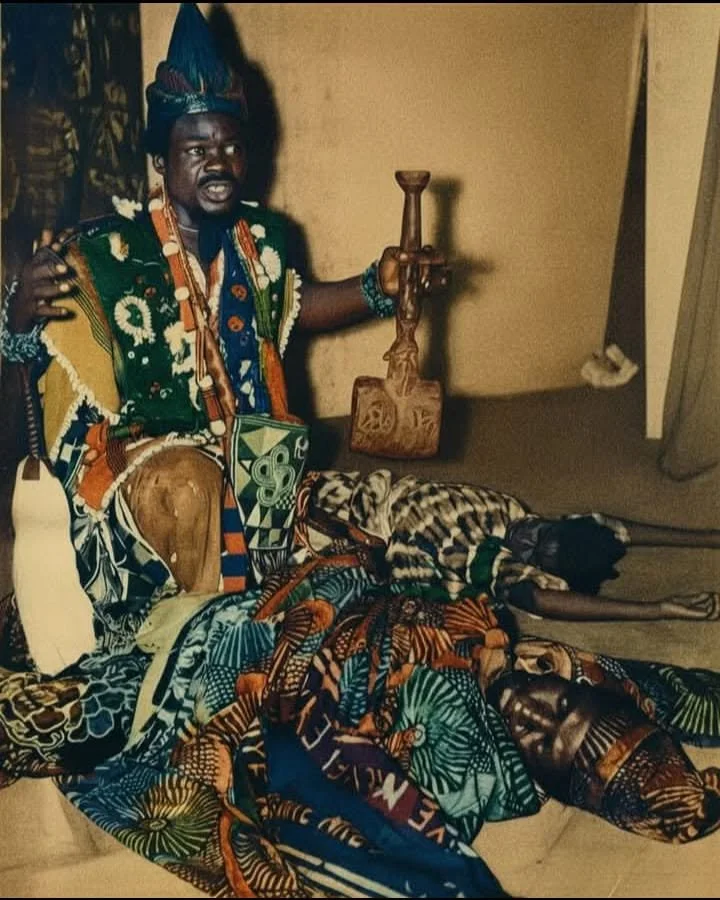
Credit: @alimiidris via Instagram. Original photographer not identified in the post.
Duro Ladipo performing Ọba kò so in 1967, embodying Ṣàngó in the Yoruba music-and-dance drama that became his defining theatrical work. The Instagram post identifies the photograph as Ladipo performing the play in 1967.
Who Was Duro Ladipo?
Duro Ladipo was a playwright, actor, composer, director, and one of the major figures in twentieth-century Yoruba theatre. He was born in Osogbo and built much of his artistic career around Yoruba-language performance.
His theatre drew from Yoruba history, oral literature, religious traditions, music, and performance rather than simply placing a Yoruba story inside a Western-style play.
Ladipo was also an active researcher. Scholarship on his theatre notes that he consulted written histories such as Samuel Johnson's The History of the Yorubas, then visited communities connected to the events to gather additional accounts before transforming the material dramatically.
That approach is important. He was not merely borrowing colourful legends for entertainment. He was interpreting stories already carried through generations and finding a new stage for them.
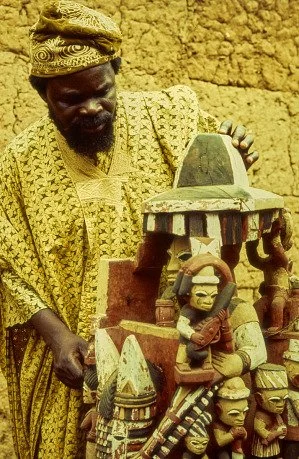
Credit: John Pemberton III Collection, Eliot Elisofon Photographic Archives, National Museum of African Art, Smithsonian Institution.
Duro Ladipo examines an Ẹpa sculpture in Ekiti in 1974, reflecting the close attention he gave to Yoruba artistic and ritual traditions beyond the theatre itself.
From Church Music to Yoruba Theatre
Ladipo grew up in a Christian household and gained early experience with church music, but the cultural world around Osogbo offered another education.
Yoruba festivals, drumming, oral stories, praise traditions, and religious performance became central to the theatre he eventually developed. His work emerged at a moment when Nigerian artists were asking what a modern theatre rooted in local artistic forms could look like.
His answer was not to separate acting from music.
In Ladipo's theatre, speech could become song, movement could carry narrative, and percussion could tell the audience how a scene should feel. The performance depended on the interaction of several forms rather than dialogue alone.
That connection makes NKENNE's guide to Yoruba talking drums especially useful: in Yoruba performance, drums are capable of carrying language, praise, rhythm, and social meaning rather than functioning as background sound.
Oba Koso: When Sango Became Theatre
The work most closely associated with Ladipo is Ọba kò so, commonly translated as The King Did Not Hang.
The play reworks the story of Ṣàngó, remembered in Yoruba tradition as an Alaafin of Oyo who later became one of the most important òrìṣà. Ladipo's version explores the political conflict and downfall surrounding the king while moving toward the declaration contained in its title: the king did not simply die.
Ladipo himself became closely associated with the role of Ṣàngó.
What made the production remarkable was that the story was not carried by dialogue alone. Music, dance, costume, ritual poetry, drums, praise language, and movement created the world around the king. Smithsonian records describe Ọba kò so as a Nigerian music-and-dance drama and preserve recordings by the Duro Ladipo National Theatre.
For audiences unfamiliar with Yoruba, much of the emotional force could therefore survive without every word being translated.
Theatre became another way for an oral tradition to travel.
How Ladipo Built a Yoruba Stage Language
Ladipo's productions did not treat Yoruba culture as scenery.
Studies of his theatre describe a form built from music, movement, costume, visual symbolism, oral poetry, and indigenous performance practices. His major works included Ọba kò so, Ọba Moro, and Ọba Waja.
Drumming was especially important. Performers trained in traditions such as dùndún and bàtá worked within his company, allowing rhythm to function as part of the storytelling rather than simply accompany it.
The Yoruba language itself was equally central.
Its tonal movement, proverbs, praise forms, repetition, and sung passages gave the productions a sound that could not simply be recreated by substituting English dialogue. Ladipo demonstrated that Yoruba could carry large-scale modern theatre while remaining connected to older performance traditions.
That relationship between performance and the unseen world also appears elsewhere in Yoruba culture. NKENNE's guide to Egungun masquerades explores another tradition in which costume, movement, music, and spoken performance meet.
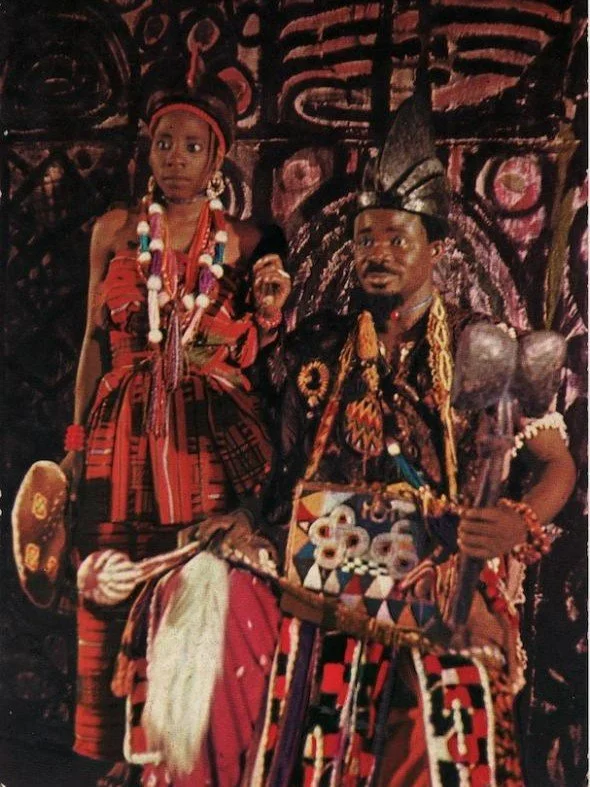
Credit: Centre for Black Culture and International Understanding, Osogbo & Iwalewahaus, University of Bayreuth. Backdrop by Georgina Beier.
Abiodun Ladipo stands before a backdrop created by Georgina Beier for Duro Ladipo’s theatre group, revealing how costume, painting, symbolism, and performance were brought together to build a distinctly visual Yoruba stage language.
Mbari Mbayo and the Osogbo Arts Scene
Ladipo's work did not develop in isolation.
In the early 1960s, he helped establish Mbari Mbayo in Osogbo, an artists' and writers' space that became an important meeting ground for theatre and the visual arts. Archival scholarship records the transplantation of the Mbari idea to Osogbo in 1962 and its role in workshops for emerging artists.
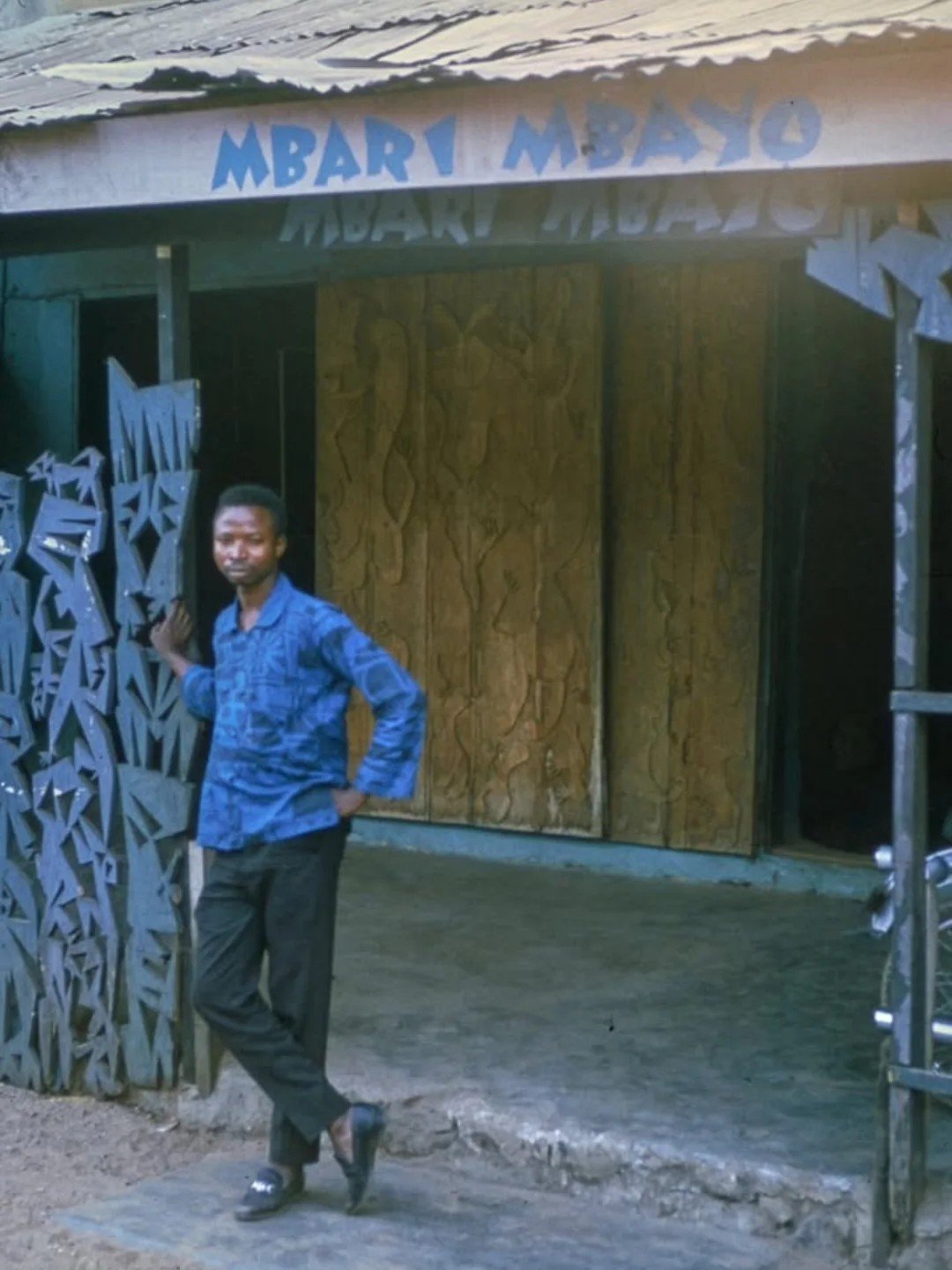
Credit: John Pemberton III Collection, Eliot Elisofon Photographic Archives, National Museum of African Art, Smithsonian Institution. Text reference via ASIRI Magazine, 2025.
The Mbari Mbayo Club and Studio in Osogbo became a creative meeting ground for theatre, visual art, workshops, and experimentation, with Duro Ladipo at the centre of its developing performance scene.
For Ladipo, it provided more than a venue.
Actors, musicians, designers, painters, and other artists could work around one another. Several artists associated with the developing Osogbo art movement also had connections with his theatre company.
That environment helps explain why Ladipo's productions were so visually distinctive. Theatre could draw from costume, set design, painting, percussion, dance, and oral performance at once.
Mbari Mbayo became part workshop, part theatre, and part cultural meeting place.
From Osogbo to International Stages
The language was Yoruba. The stories were deeply local. The audiences did not stay local.
Ladipo's company performed Ọba kò so at the Berlin arts festival in 1964, where the production received major attention. In 1965, the company appeared at the Commonwealth Arts Festival in Britain and continued touring internationally.
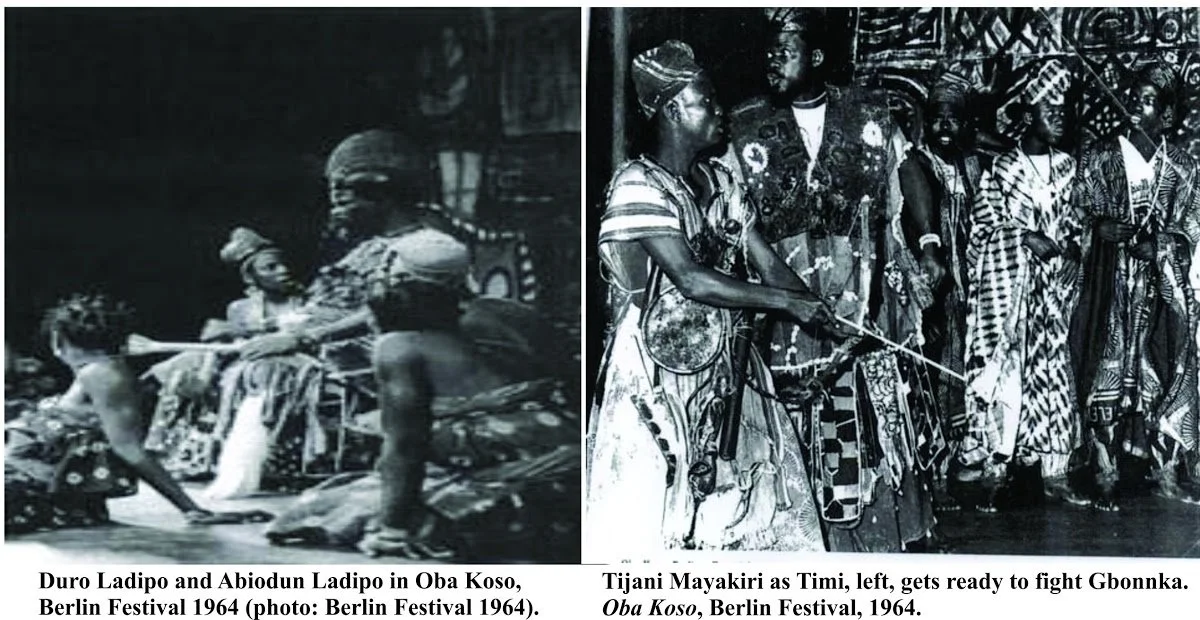
Credit: Berlin Festival, 1964, reproduced via CafeAfricana.
Duro and Abiodun Ladipo perform Ọba kò so at the Berlin Festival in 1964, one of the international appearances that carried Yoruba-language theatre from Osogbo to audiences abroad.
Its success challenged an easy assumption: that culturally specific theatre must become less specific before outsiders can understand it.
Ladipo largely did the opposite.
The drums stayed. Yoruba remained central. Ṣàngó remained Ṣàngó. The visual and musical language of the production gave international audiences another way into the story.
His work therefore helped place modern Yoruba theatre within a wider global conversation without requiring it to abandon the cultural forms that made it Yoruba.
Ladipo died in Osogbo in 1978, but archives, recordings, scholarship, performances, and the preservation of material connected to his theatre continue to keep the work accessible. The Centre for Black Culture and International Understanding has also undertaken efforts connected to preserving his Mbari Mbayo legacy and archival materials.
FAQs
What was Duro Ladipo famous for?
He was a Yoruba playwright, composer, actor, and theatre director best known for combining Yoruba oral tradition, music, dance, religious narrative, and historical material in works such as Ọba kò so.
What is Oba Koso about?
Ọba kò so retells the story of Ṣàngó, the Yoruba king associated with Oyo who becomes the òrìṣà of thunder in Yoruba tradition. The play explores his political downfall and transformation into a sacred figure.
Did Duro Ladipo perform in his own plays?
Yes. Ladipo was not only a writer and director but also a performer, and he became particularly associated with playing Ṣàngó in Ọba kò so.
What was Mbari Mbayo?
Mbari Mbayo was an arts and cultural space established in Osogbo in the early 1960s. It supported theatre, visual art, workshops, and collaboration among emerging artists.
Was Duro Ladipo born in 1926 or 1931?
Published sources have given both years. More recent biographical scholarship, including work cited through the Dictionary of African Biography, gives 18 December 1926, while older references sometimes list 1931. His death on 11 March 1978 is consistently recorded.
Why does Duro Ladipo still matter?
His theatre showed that Yoruba language, history, ritual poetry, drumming, dance, and oral narrative could form the foundation of ambitious modern drama rather than serve merely as decoration within it. His works remain part of scholarship and archival collections devoted to African theatre.
Conclusion
Duro Ladipo did not simply take Yoruba stories and place them beneath stage lights.
He built theatre from the systems that had already carried those stories: voice, rhythm, memory, praise, movement, costume, and communal performance.
Ọba kò so became his defining work because it showed what could happen when an old story entered a modern theatre without leaving its cultural language behind.
From Osogbo to Berlin and beyond, Ladipo proved that a story could travel precisely because of its specificity, not despite it.
Learn Yoruba Through the Stories Behind It
With NKENNE, Yoruba becomes more than vocabulary.
Learn the language alongside the histories, performances, music, and traditions that give its words their cultural weight, then continue exploring Yoruba in the NKENNE app.
