
Simple Present Tense with Waa in Somali: How to Build Basic Sentences
By: Chimdindu Ken-Anaukwu
One of the first things you need to speak Somali is the simple present tense. It is how you talk about everyday actions like eating, going, or working.
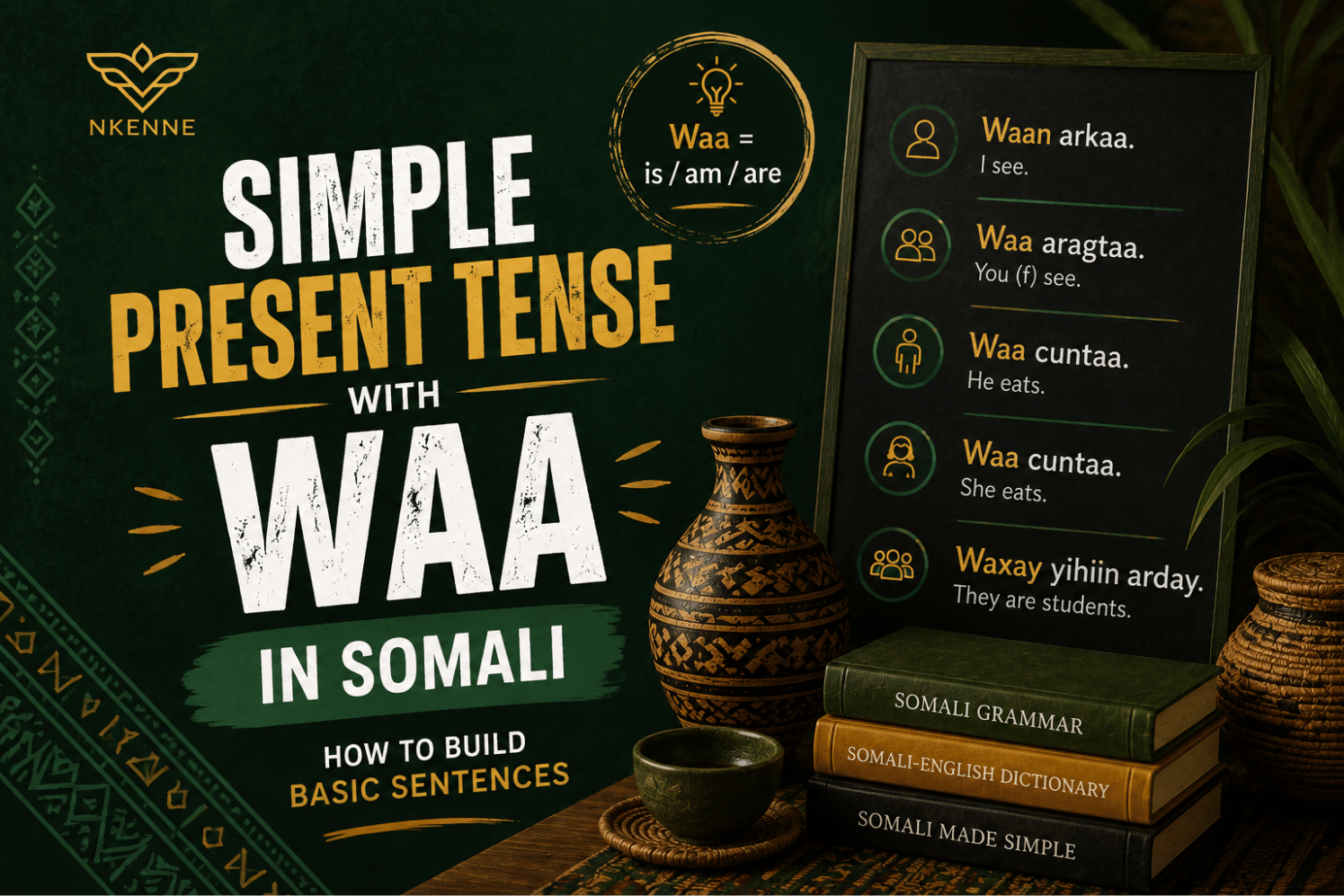
In Somali, the particle waa plays a central role. It helps form affirmative sentences and works with subject pronouns to show who is doing the action.
In this NKENNE guide, you will learn how to form basic present tense sentences using waa, subject pronouns, and common verbs.
What Is the Simple Present Tense in Somali?
The simple present tense describes habitual actions or general truths. It is one of the most useful tenses for beginners.
Unlike English, Somali often places the object before the verb and uses focus particles like waa to mark the main information in the sentence.
Subject Pronouns
Here are the main subject pronouns:
Aniga / Anigu — I
Adiga / Adigu — You (singular)
Isaga — He
Iyada — She
Annaga — We
Idinka — You (plural)
Iyaga — They
The forms ending in “-gu” (Anigu, Adigu) are often used for emphasis.
How Waa Works with Subject Pronouns
The particle waa changes slightly depending on the subject:
Waan — I
Waad — You (singular)
Wuu — He
Way — She
Waanu / Waynu — We
Waadin — You (plural)
Way — They
These forms combine the focus particle with the subject marker.
Basic Sentence Structure
A common pattern is:
Subject + Object + Waa-form + Verb
Example: Anigu bariis waan cunaa. (I eat rice.)
Breakdown:
Anigu = I (emphatic)
bariis = rice
waan = I (with waa)
cunaa = eat (present tense)
You can drop the full subject pronoun once the waa-form makes the subject clear: Bariis waan cunaa. (I eat rice.)
Common Verbs in the Present Tense
Here are useful everyday verbs:
Cun (eat) → cunaa
Cab (drink) → cabaa
Tag (go) → tagaa
Imid (come) → yimaadaa
Samee (do/make) → sameeyaa
Akhri (read) → akhriyaa
Qor (write) → qoraa
The verb ending changes according to the subject. For “I”, the ending is often -aa.
Practice Sentences
Anigu shaah waan cabaa. (I drink tea.)
Adigu bariis waad cunaa. (You eat rice.)
Isagu suuqa wuu tagaa. (He goes to the market.)
Iyadu buug way akhriyaa. (She reads a book.)
Annaga canjeero waanu cunnaa. (We eat canjeero.)
Practice saying these out loud. Notice how the object often comes before the verb.
FAQs
What does “waa” mean in Somali?
Waa is a focus particle used in affirmative sentences. It highlights the information that follows and works with subject markers.
Do I always need to use the full subject pronoun?
No. Once the waa-form shows the subject, you can often omit Anigu, Adigu, etc.
Is the word order fixed?
Somali is flexible, but the common everyday order is Subject + Object + Verb with the waa particle placed before the verb.
How do I say negative sentences?
Negatives use different particles (such as ma). This lesson focuses on affirmative present tense with waa.
Can I use waa with any verb?
Yes. Waa combines with most verbs in the present tense when making positive statements about current or habitual actions.
Mastering the simple present tense with waa gives you the foundation to talk about daily life in Somali. Start with a few common verbs and build short sentences every day.
Continue your Af Soomaali journey on the NKENNE app. The next lesson will help you expand these sentences with more verbs and real conversations. You are making solid progress.