
By: Chimdindu Ken-Anaukwu
On an Angolan lunch table, there is often one dish at the centre that everything else depends on. It is pale, smooth, and soft, and it sits next to a rich stew of chicken, fish, or meat cooked in palm oil.
That dish is funge. It does not shout for attention, but an Angolan meal without it can feel incomplete. Funge is what you scoop, what soaks up the sauce, and what makes a stew into a proper meal.
In this guide, you will learn what funge is, the difference between cassava and maize funge, the Portuguese words you will hear in an Angolan kitchen, how to make it at home, and what to serve it with.
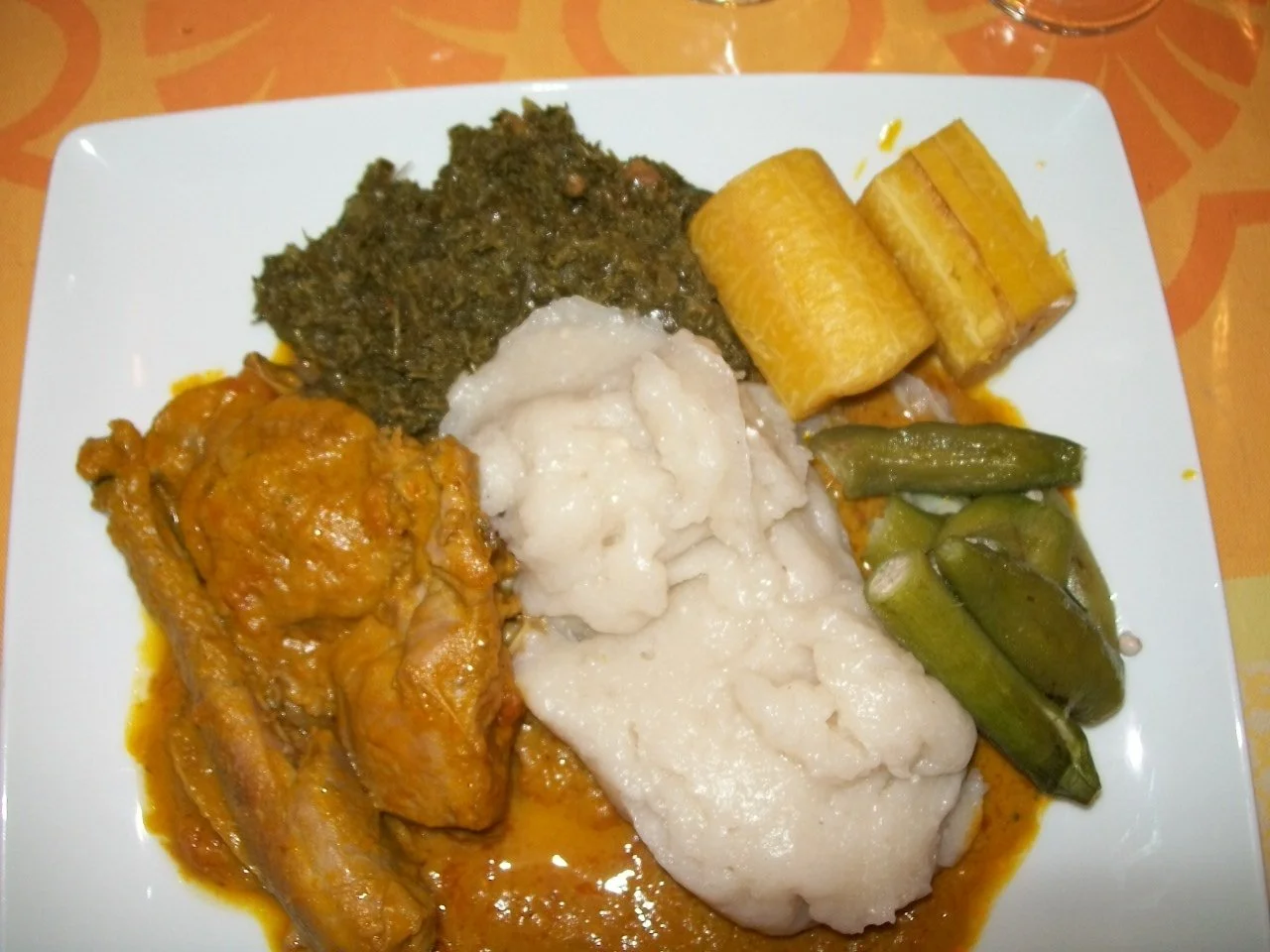
Moamba de galinha with funge, greens, okra, and plantain in Luanda. Photo: Rui Gabriel Correia, CC BY-SA 3.0, via Wikimedia Commons
What Is Funge?
Funge (also spelled funje) is a thick, smooth porridge made by cooking flour in boiling water and stirring it hard until it becomes glossy and stretchy. It is one of the most important staple foods in Angola.
Funge itself is plain. Its job is to carry flavour, not to bring it. It is served alongside stews and sauces, and each bite of funge is eaten together with the stew.
If you know West or East African food, funge will feel familiar. It belongs to the same family as fufu in West Africa and ugali in East Africa: a simple starch, cooked and stirred until smooth, that turns any stew into a filling meal.
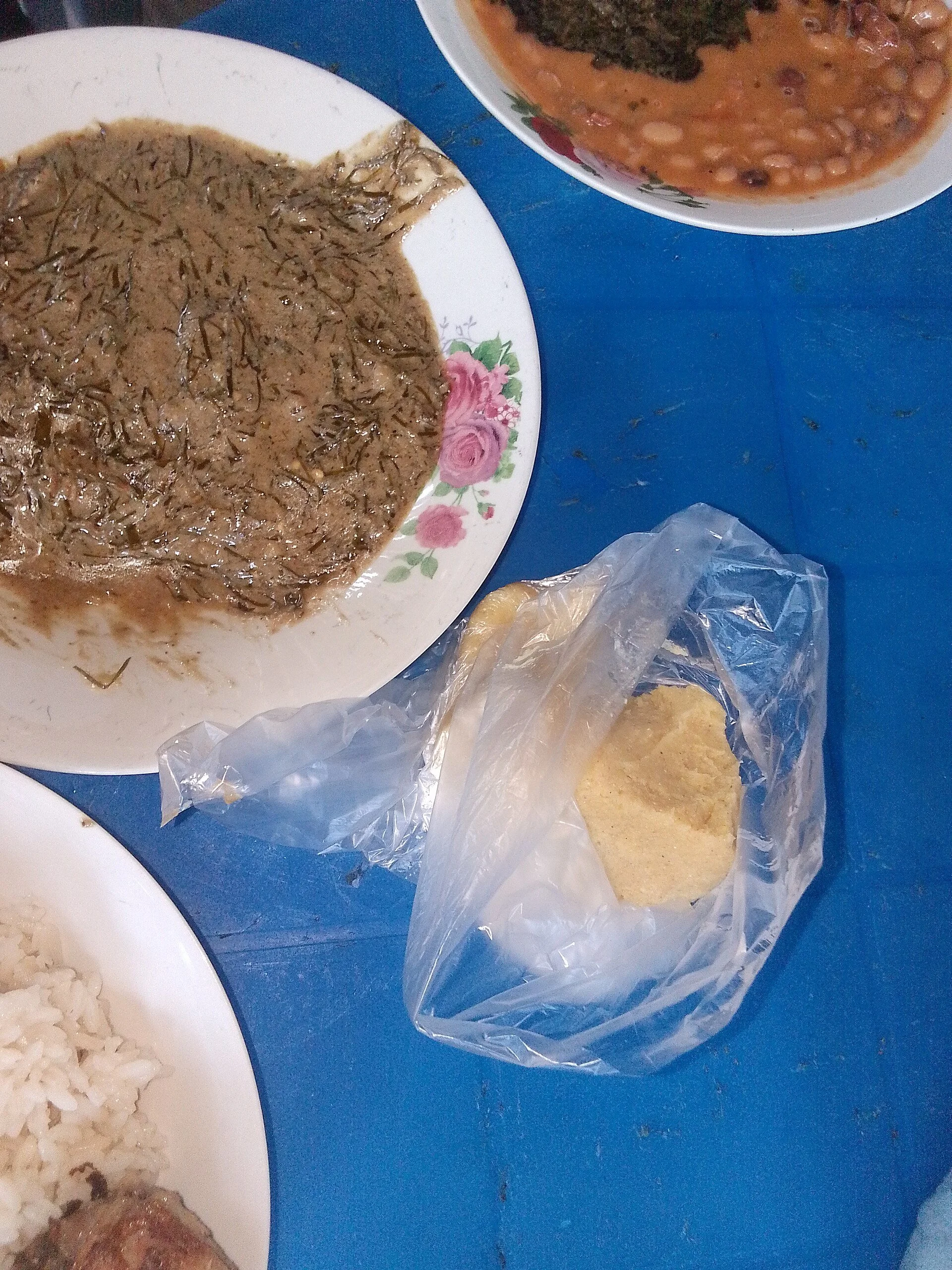
Funge de Bombó vs. Funge de Milho
There are two main kinds of funge in Angola, and the one you eat often depends on where you are.
Funge de bombó. This is the cassava version, made with cassava flour, known as fuba de bombó. It is especially associated with Luanda and the north of the country. It is pale white or greyish, very smooth, and slightly elastic, with a gentle tang from the fermented cassava.
Funge de milho. This is maize funge, made with maize flour, fuba de milho. It is more common in the south and centre of Angola. It is yellow or off-white, a little firmer, and has a mild, sweet corn flavour.
Both are eaten the same way, with a stew or sauce, and both are cooked with the same technique. Many Angolan families have a strong preference for one or the other, usually the one they grew up with.
Portuguese Words for the Angolan Kitchen
Angola's official language is Portuguese, and food is one of the easiest ways to start learning it. Here are some words you will hear around a pot of funge:
Fuba: flour, as in fuba de bombó (cassava flour) or fuba de milho (maize flour)
Mandioca: cassava
Milho: maize or corn
Colher de pau: wooden spoon, the essential tool for making funge
Panela: pot or pan
Água a ferver: boiling water
Óleo de palma: palm oil, the base of many stews served with funge
Bom apetite!: "Enjoy your meal!"
Say it the next time you serve a plate: Bom apetite!
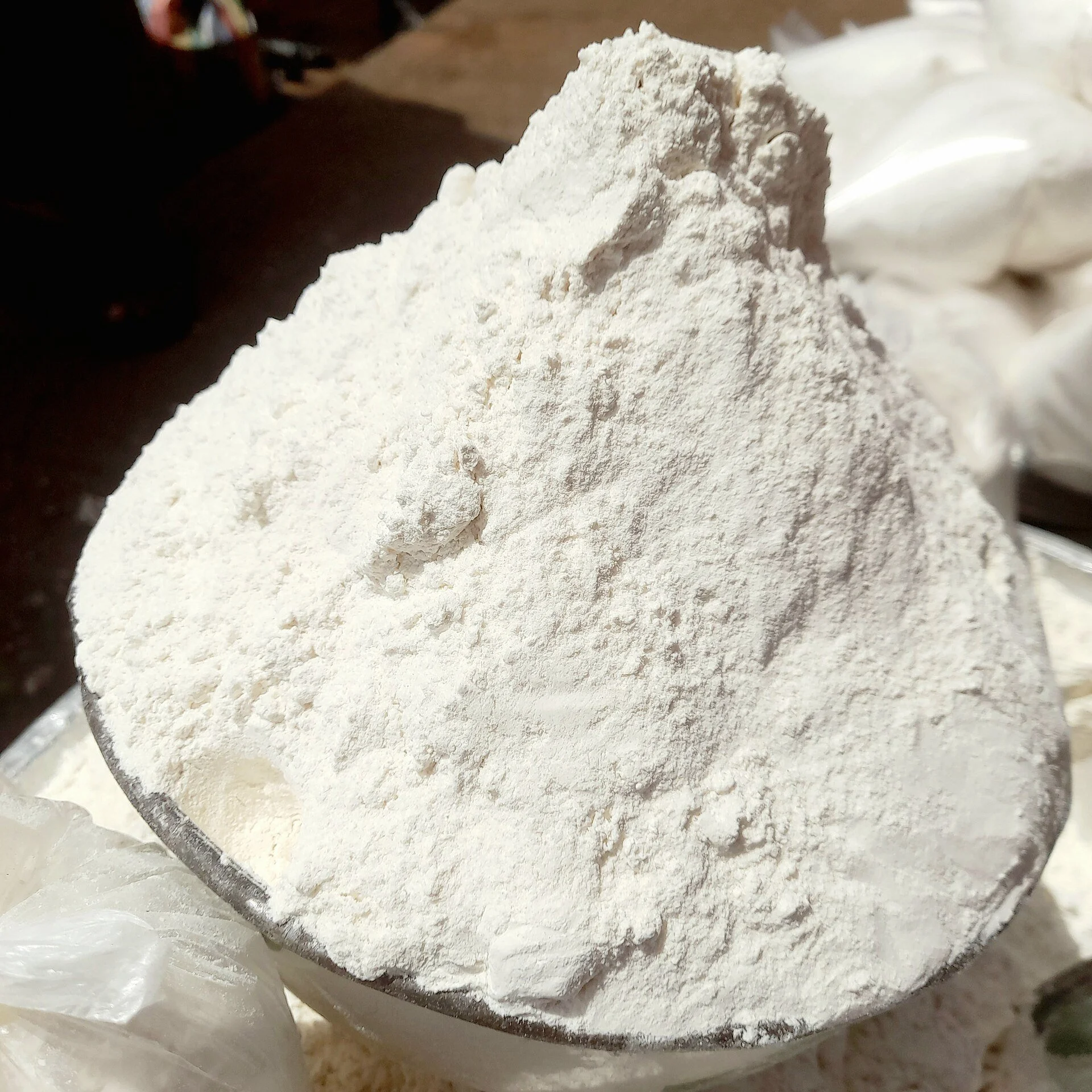
Cassava flour, the base of funge de bombó. Photo: Hajia Hijjah, CC BY-SA 4.0, via Wikimedia Commons
How to Make Funge
Funge has only two ingredients, but making it well takes a strong arm. The secret is constant, vigorous stirring, because lumps are the sign of poorly made funge.
Prep time: 2 minutes
Cook time: 10 minutes
Serves: 4
Ingredients
2 cups cassava flour (fuba de bombó) or fine maize flour (fuba de milho)
About 4 cups water, roughly twice the amount of flour
Step-by-Step Guide
Bring the water to a rolling boil in a heavy pot. Pour about one cup of the boiling water into a jug and set it aside.
Lower the heat. Add the flour to the pot a little at a time, stirring with a wooden spoon as you go.
Stir hard. Press the funge against the side of the pot and fold it over itself, again and again, to break up every lump. This is the most important step.
If the funge feels too stiff to stir, add a splash of the reserved hot water and keep working it in.
Keep stirring for a few more minutes until the funge is smooth, glossy, and slightly stretchy, and it pulls away from the sides of the pot.
Wet a bowl or a large spoon with water and use it to shape the funge into a smooth mound. Serve it hot, straight away.
Helpful tips
For fewer lumps, mix the flour with a little cold water to make a paste before adding it to the boiling water.
Funge firms up as it cools, so cook it last, when the stew is ready.
Maize funge usually needs a little longer on the heat than cassava funge.
Use a sturdy pot. Funge is heavy work, and a light pan will slide around the stove.
What to Serve With Funge
Funge is always part of a pair. Here are the dishes it is most often served with.
Moamba de galinha. Chicken cooked in a rich palm oil sauce, often with okra, garlic, and chilli. It is widely considered Angola's national dish, and funge is its classic partner.
Calulu. A hearty stew of dried fish or dried meat cooked with vegetables such as okra, sweet potato leaves, and tomato, usually in palm oil. Calulu with funge is a favourite family meal.
Fish and meat stews. Grilled or stewed fish, goat, and beef dishes are all regularly served with funge, especially in coastal Luanda where fresh fish is easy to find.
Greens and beans. Cassava leaves, beans in palm oil, and other vegetable dishes often appear on the same table, so everyone can build their own plate.
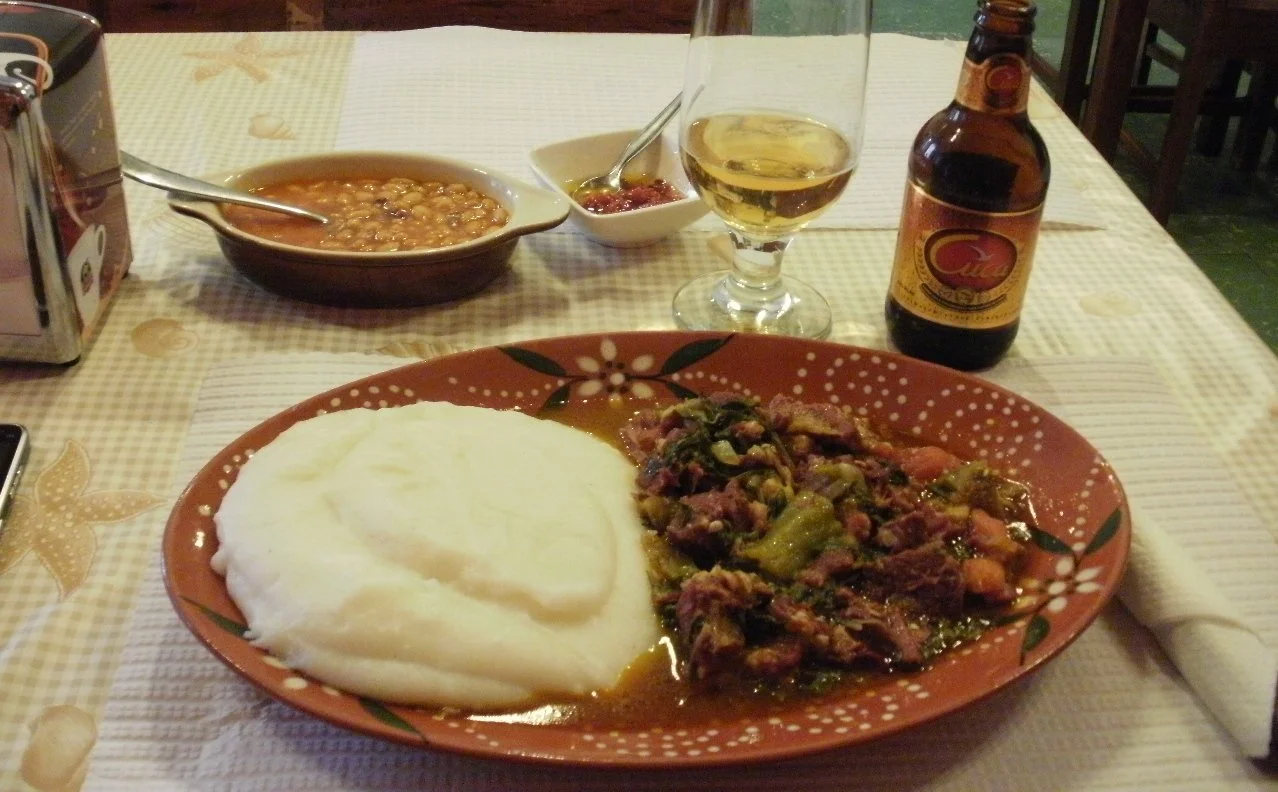
Calulu of dried meat and okra in palm oil, served with maize funge (funje de milho). Photo: Jrobal0, CC BY-SA 4.0, via Wikimedia Commons
Funge at the Angolan Table
In Angola, funge is everyday food, but it is also comfort food. It is the dish many Angolans miss most when they live abroad, and the one they cook first when they want a taste of home.
Funge is usually made fresh for each meal, because it is best eaten hot. In many homes, making it is a shared job, with one person adding the flour while another stirs. Children often grow up watching an older relative work the wooden spoon and learning how the funge should look and feel when it is ready.
On weekends and special occasions, funge is served with the big dishes: moamba, calulu, and generous pots of fish or meat. The table fills up, the family sits down together, and the funge disappears long before the conversation ends.
Funge's Cousins Across Africa
If funge feels familiar, that is because many African countries have their own version of a soft, stretchy staple made from flour and water. The names change from place to place, but the idea is the same: a neutral, filling base that you eat with your hands or a spoon alongside a flavourful stew.
Fufu – a name used across West and Central Africa, including in the Democratic Republic of the Congo, where cassava fufu is close to Angola's funge de bombó.
Nshima – Zambia's everyday staple, made from white maize meal.
Nsima – the Malawian name for a very similar maize dish.
Ugali – the maize staple of Kenya and Tanzania.
Pap – South Africa's maize porridge, which can be soft, stiff, or crumbly.
Xima – Mozambique's version, another Portuguese-speaking neighbour of Angola.
What makes funge stand out is its texture. Cassava funge is smoother, glossier, and more elastic than most maize staples, and it has a gentle sourness when it is made from fermented cassava flour.
Comparing these dishes is also a lovely way to explore African languages. Each name carries a little of the history of the people who cook it, and learning what your neighbours call their staple is often the start of a much bigger conversation about food and home.
Frequently Asked Questions
What is funge made of?
Funge is made from flour and water. In northern Angola it is usually made with cassava flour (funge de bombó), and in the south with maize flour (funge de milho).
Is funge the same as fufu?
They are closely related. Both are smooth starchy dishes eaten with stews, but fufu in West Africa is often made from pounded cassava, yam, or plantain, while funge is made by stirring flour into boiling water.
What do you eat with funge?
Funge is served with stews and sauces, especially moamba de galinha (chicken in palm oil sauce) and calulu (dried fish or meat stew with vegetables).
How do you avoid lumps in funge?
Add the flour gradually and stir constantly and firmly with a wooden spoon. Mixing the flour with a little cold water first also helps.
Does funge have a taste?
Funge has a mild flavour. Cassava funge is slightly tangy, and maize funge is a little sweet. Its main role is to carry the flavour of the stew.
How do you say "enjoy your meal" in Portuguese?
Bom apetite!
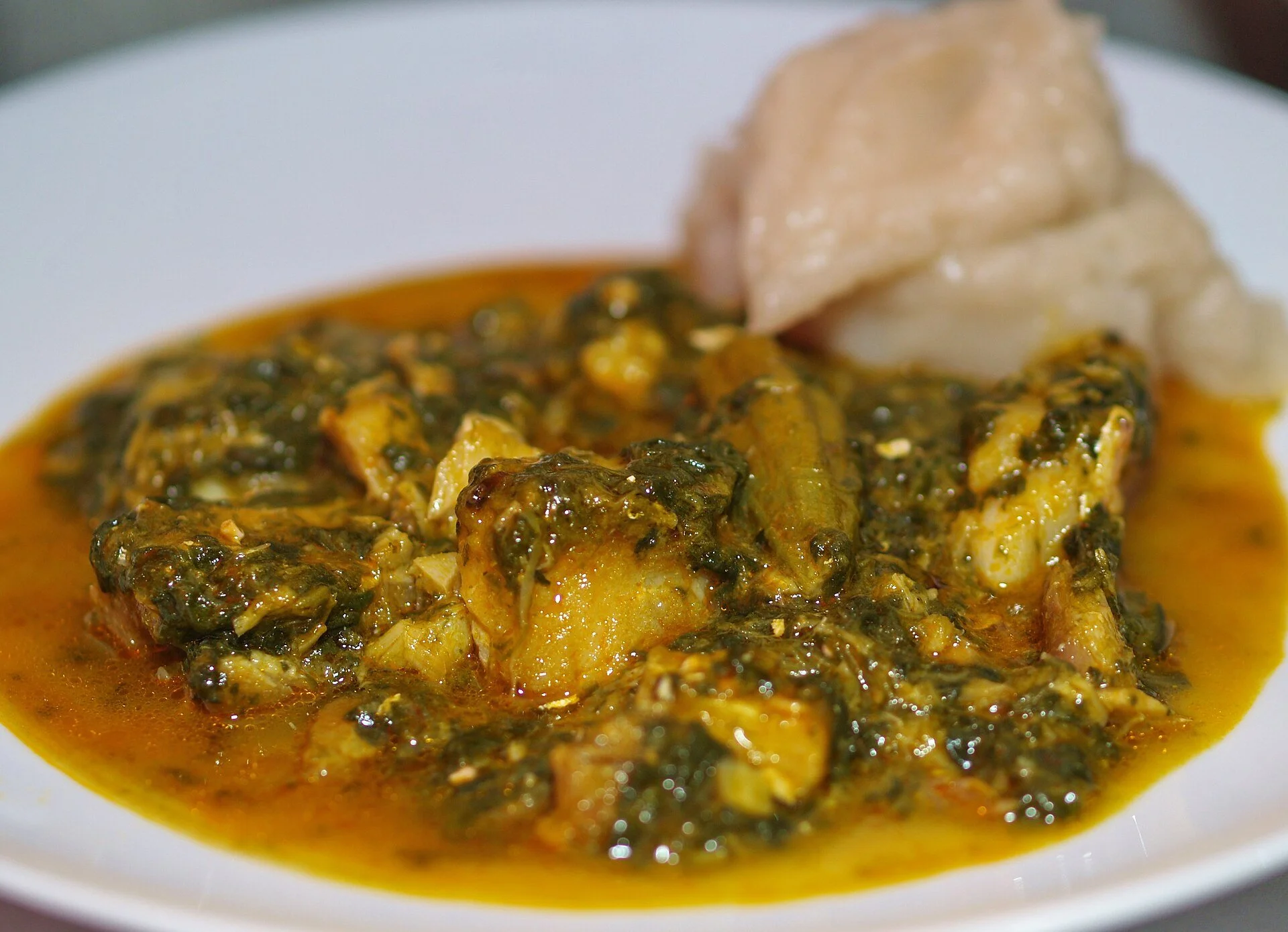


Fish calulu, a classic stew from Angola and São Tomé and Príncipe. Photo: elingunnur, CC BY 3.0, via Wikimedia Commons

Funge proves that the simplest food can carry the deepest sense of home. Flour, water, a wooden spoon, and a strong arm are all it takes to make the dish that holds an Angolan meal together.
Try making it this week. Cook a stew, stir your funge until it shines, and share it with the people at your table.
If this recipe made you want to learn the language of the Angolan kitchen, keep learning Portuguese with NKENNE. Our lessons take you from everyday greetings to the words you need around the table.
Obrigado for cooking with us. Bom apetite! 🍲