
By: Chimdindu Ken-Anaukwu
In the crowded bars and open-air dances of mid-century Kinshasa, one guitar sound cut through everything. Fluid, rhythmic, and impossible to ignore, it belonged to François Luambo Makiadi, better known simply as Franco. Fans and fellow musicians called him the Sorcerer of the Guitar. For more than three decades, he led OK Jazz (later TPOK Jazz) and helped shape Congolese rumba into the dominant sound of Central and much of Africa.
This article explores Franco’s life, the rise of his legendary orchestra, and the lasting power of the Lingala-language music he created.
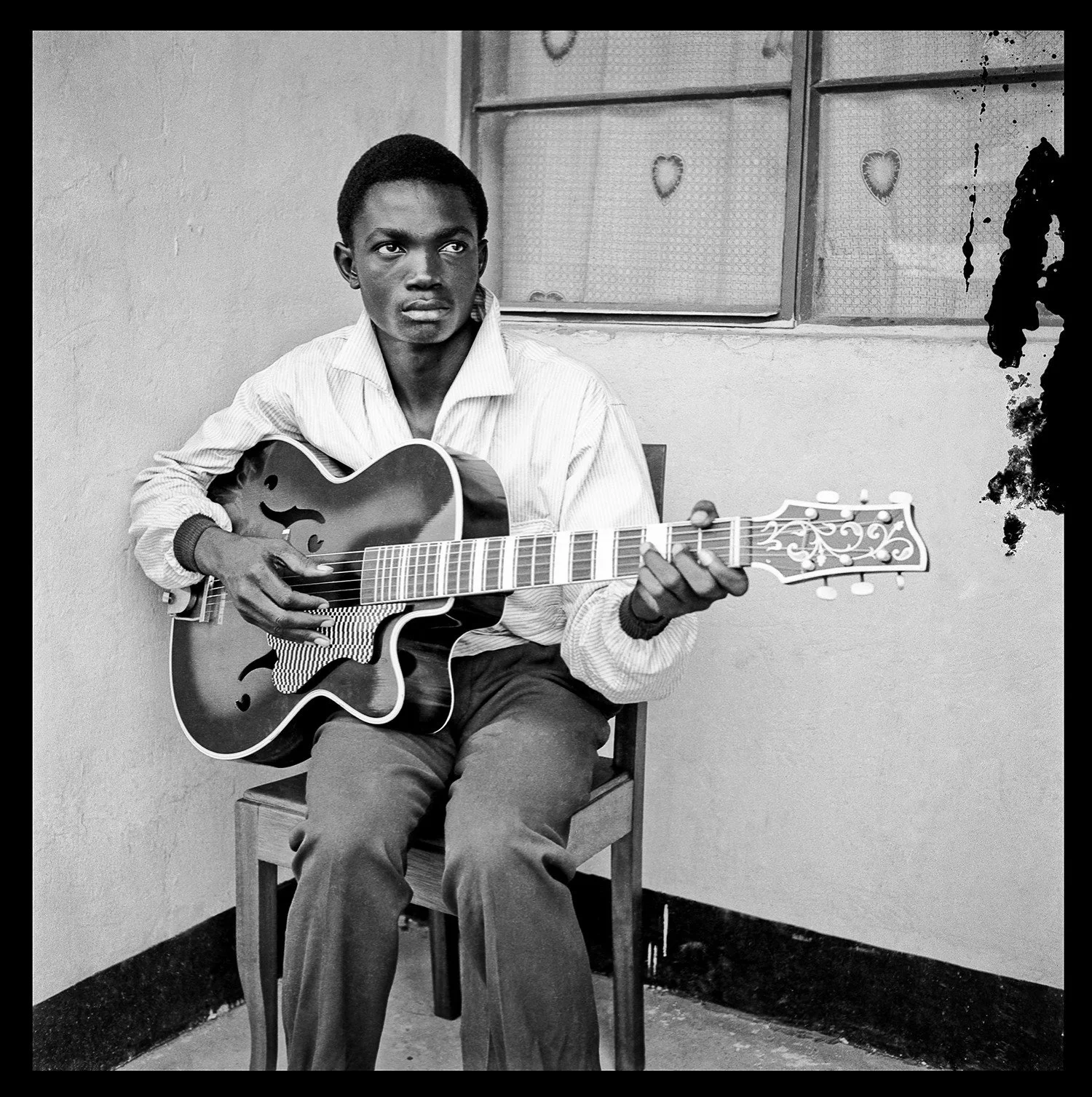
A young Franco Luambo playing guitar outside a house in Léopoldville, 1956. Photo: Jean Depara, CC BY-SA 4.0, via Wikimedia Commons
Early Life and the Making of a Guitarist
François Luambo Luanzo Makiadi was born on 6 July 1938 in Sona-Bata in what is now Kongo Central province. His family later moved to Léopoldville (today’s Kinshasa), where he grew up in a working-class neighborhood.
He showed musical talent early. As a boy he built his own guitar and began playing seriously in his teens. By the early 1950s he was already recording and performing. Producer Henri Bowane at the Loningisa studio gave him the stage name “Franco.” His first notable recordings appeared while he was still a teenager.
The Birth of OK Jazz
In June 1956, Franco co-founded OK Jazz with clarinetist and saxophonist Jean-Serge Essous and other musicians connected to the Loningisa studio. The name came from the OK Bar where the group first performed regularly. Their motto, “On Entre OK, On Sort KO” (You enter OK, you leave knocked out), captured the band’s confident energy.
The early OK Jazz sound blended Cuban-influenced rumba rhythms with Congolese guitar patterns and Lingala vocals. Franco’s inventive playing quickly set the group apart. Within a few years the band became one of the two dominant forces in Congolese popular music, rivaling African Jazz led by Joseph Kabasele and later Dr. Nico.
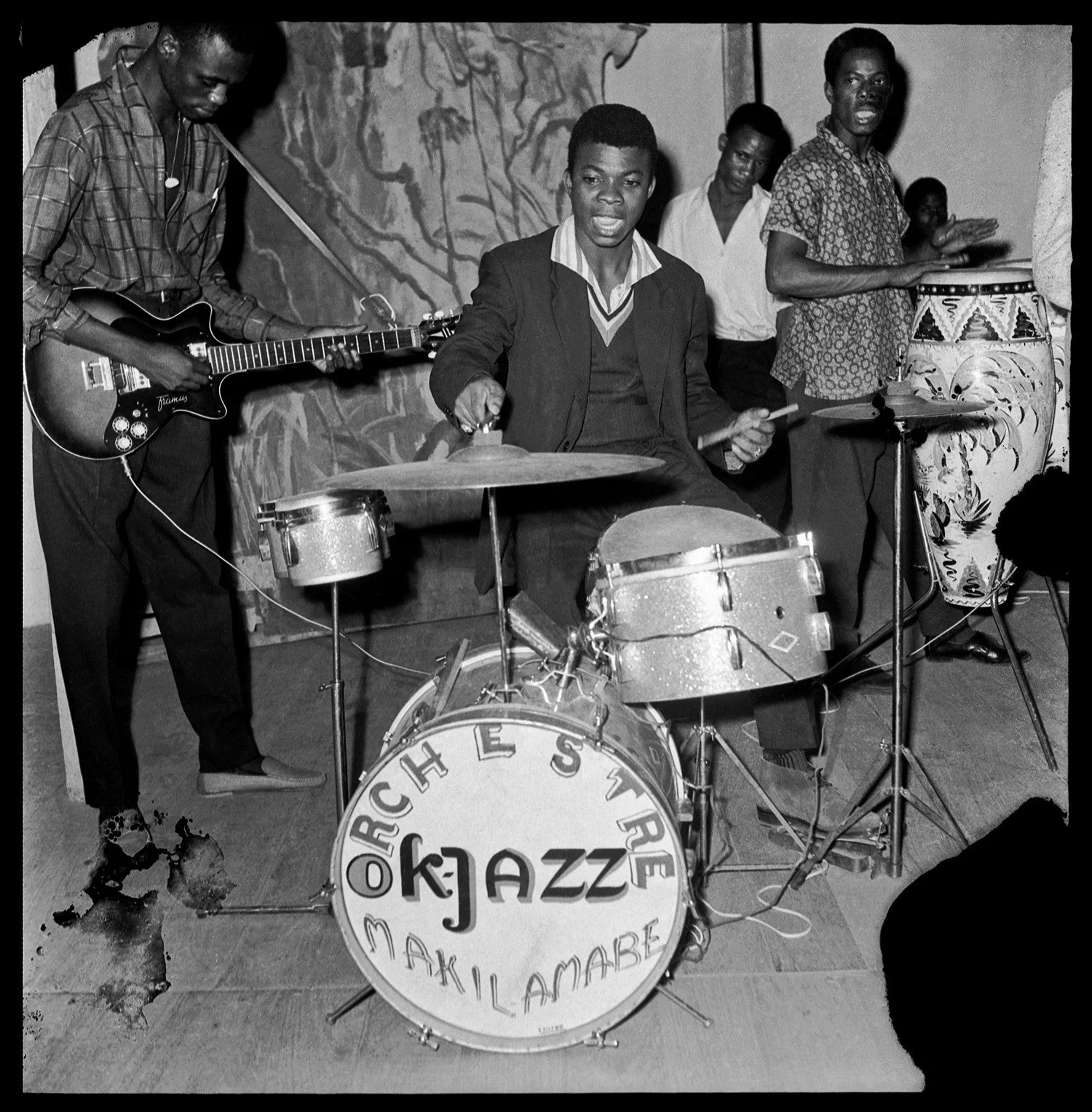
The drummer of Franco’s OK Jazz in Léopoldville (now Kinshasa). Photo: Jean Depara, CC BY-SA 4.0, via Wikimedia Commons
From OK Jazz to TPOK Jazz: Building an Empire
As the years passed, Franco assumed full leadership. In the early 1970s the group became known as TPOK Jazz (Tout Puissant Orchestre Kinois de Jazz — the All-Powerful Kinshasa Jazz Orchestra). At its height the orchestra often included more than twenty musicians, with a large horn section, multiple guitarists, and strong vocalists.
Franco ran the band like a disciplined institution. He recruited and developed talent, maintained a high volume of recordings, and kept the group touring across Africa. Many musicians who later became stars passed through TPOK Jazz under his direction.
The Guitar Style That Changed Everything
Franco earned the title “Sorcerer of the Guitar” through a distinctive finger-picking approach. He often used thumb and fingers rather than a pick, creating interlocking, polyrhythmic lines. He helped popularize the extended sebene — the instrumental section that builds energy toward the end of a song — turning it into a climactic showcase.
His style became known as the “OK Jazz school,” distinct from the smoother approach associated with Dr. Nico and the African Jazz school. Generations of Congolese and African guitarists studied and adapted his techniques.
Lingala Lyrics: Love, Society, and Everyday Truths
Most of Franco’s songs were sung in Lingala, the urban lingua franca of Kinshasa. He wrote about love, jealousy, marriage, social manners, money, and the pressures of city life. Some tracks offered sharp social commentary or moral advice. Others were light and humorous.
Because the lyrics were in everyday Lingala, they reached a wide audience across ethnic lines. The combination of accessible language and strong dance rhythms helped Congolese rumba spread far beyond the Congo.
Key Songs and Lasting Hits
Franco and TPOK Jazz produced an enormous body of work. Estimates put his compositions in the hundreds, with the band releasing well over a hundred albums across the decades.
Notable tracks include early anthems such as “On Entre OK, On Sort KO,” later classics like “Mario” (a major 1980s hit about a young man living off a wealthy older woman), and songs that mixed social observation with danceable grooves. In the late 1980s he also released material addressing public health concerns of the time.
Influence Across Africa and Beyond
TPOK Jazz toured widely and their records circulated across Central, East, and West Africa. The guitar-driven Congolese sound influenced musicians from Kenya and Tanzania to Cameroon and beyond. Elements of the style later fed into the faster, more guitar-focused music known as soukous.
Franco’s impact reached outside Africa as well. Later international artists drew on the interlocking guitar patterns and rhythmic approach that he helped popularize.
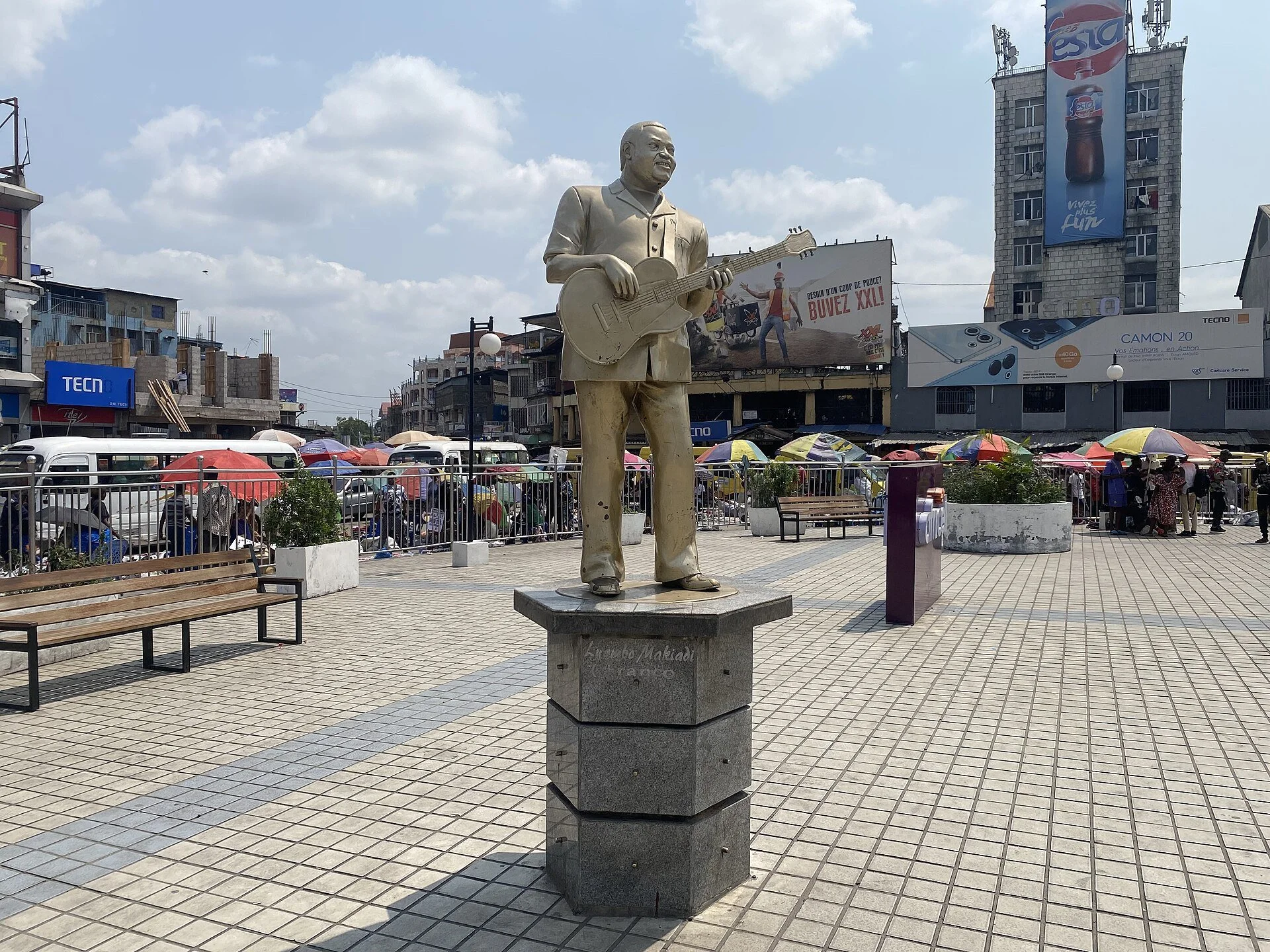


Legacy After 1989
Franco died on 12 October 1989 in Belgium at the age of 51. His death prompted national mourning in Zaire. TPOK Jazz continued for a time under other leaders, and his recordings remain widely played and studied.
Today he is remembered as one of the central figures of 20th-century African popular music — a bandleader of exceptional organizational skill, a guitarist of lasting technical influence, and a songwriter who gave Lingala a powerful public voice on the dance floor.
FAQs
Why was Franco called the Sorcerer of the Guitar?
Fans and critics used the nickname because of his fluid, inventive, and seemingly effortless finger-style playing that shaped the sound of Congolese rumba.
What does TPOK Jazz stand for?
TPOK Jazz stands for Tout Puissant Orchestre Kinois de Jazz (All-Powerful Kinshasa Jazz Orchestra). It evolved from the earlier name OK Jazz.
Did Franco sing mainly in Lingala?
Yes. Most of his well-known songs were performed in Lingala, which helped the music reach a broad urban and inter-ethnic audience.
How influential was OK Jazz / TPOK Jazz?
The band was one of the most popular and influential African orchestras of its era, shaping dance music across much of the continent for decades.
What is the sebene?
The sebene is the extended instrumental section in Congolese rumba, often featuring interlocking guitars. Franco helped make it a dramatic high point of many songs.
Is Franco’s music still relevant today?
Yes. His recordings continue to be played, sampled, and studied, and his guitar approach remains a reference point for Congolese and African musicians.
Wrapping Up: Why Franco Still Matters
Franco Luambo turned the guitar into a central voice of Congolese rumba and gave Lingala songs a lasting public stage. Through OK Jazz and TPOK Jazz he built not only a band but an institution that trained musicians, filled dance floors, and carried Kinshasa’s sound across Africa.
His combination of technical innovation, prolific songwriting, and sharp observation of everyday life keeps his music alive decades after his death.
Ready to explore more Congolese music history, Lingala culture, and the artists who shaped it? Visit NKENNE for deeper stories, practical language lessons, and authentic insights into the rhythms that still move the continent. Which Franco track do you return to most?