
By: Chimdindu Ken-Anaukwu
Walk through any busy neighborhood in Abidjan and you will hear it. Young people, market traders, drivers, and even office workers mix French with local words in a fast, playful way. That language is Nouchi. It started as the speech of street youth and grew into one of the strongest symbols of Ivorian urban identity. This post explains where Nouchi comes from, how it works, and the words you will hear most often on the streets of Abidjan.
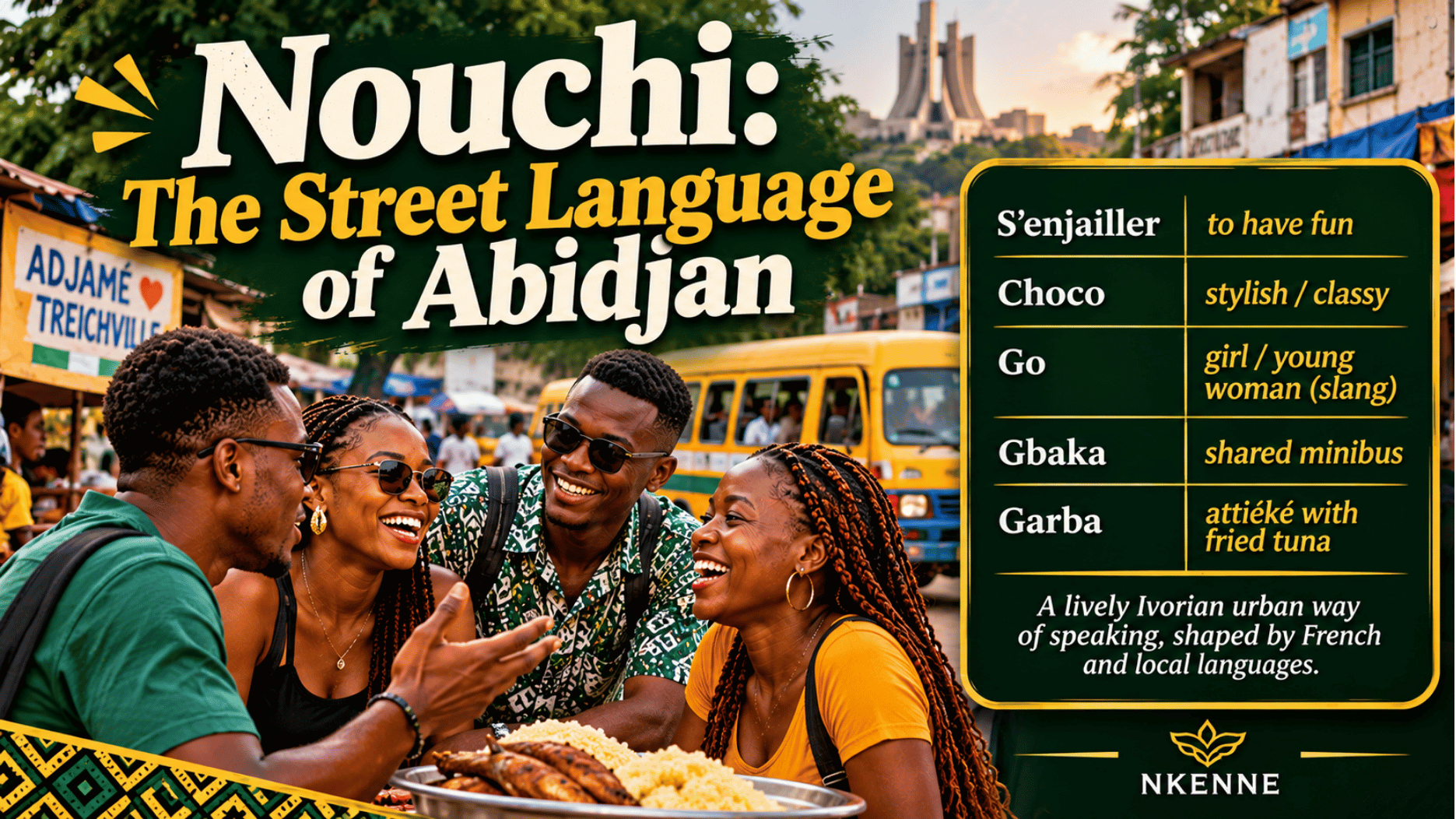
What Is Nouchi?
Nouchi is the urban slang of Abidjan and, by extension, much of Côte d’Ivoire. It is not a full independent language. It uses French grammar and sentence structure, then fills it with words from Dioula, Baoulé, Bété, English, and pure invention.
What began as coded speech among young people in popular neighborhoods is now heard across social classes. You will find it in markets, on the radio, in coupé-décalé and zouglou songs, in advertising, and even in political speeches.
How Nouchi Was Born
Nouchi emerged in the late 1970s and early 1980s in neighborhoods such as Yopougon, Adjamé, Treichville, and Abobo. Many of its first speakers were young people who had left school or lived on the margins of the formal economy.
One common explanation for the name links it to Dioula words for “nose” and “hair,” referring to the moustaches worn by tough guys in popular Western films of the time. The word first described the street youth themselves before it came to name their way of speaking.
Music played a major role in spreading Nouchi. Zouglou in the 1990s and later coupé-décalé carried the slang far beyond Abidjan’s working-class areas.
How the Language Works
Nouchi keeps the basic structure of French but changes the vocabulary heavily. Speakers borrow freely, invent new words, shorten existing ones, and give ordinary French words new meanings.
A single conversation can move between standard French, Nouchi words, and local language expressions without anyone switching fully. The result feels fast, creative, and full of attitude. New words appear regularly, so the slang stays fresh.
Essential Nouchi Words and Phrases
Here are some of the most common and useful words:
Go or la go — a girl or young woman
Djo or môgo — a guy, a friend, a mate
Gaou — a naive or uncool person
S’enjailler — to have fun, to enjoy oneself
Boucantier — a show-off, someone who loves to display style and money
Kpakpato — a gossip or meddler
Ya fohi — there’s nothing / no problem
Gbê — the truth
Bara — work
Wôrô-wôrô — shared taxi
Babi — Abidjan
Groto — a rich or important person
Drap — a problem or complication
You will also hear money terms such as togo or mambi for 100 CFA and chelsea for 2,000 CFA.
Nouchi in Music and Everyday Life
Nouchi thrives in Ivorian music. Artists use it to sound authentic, funny, and close to the street. Coupé-décalé in particular made many Nouchi expressions famous across West Africa and in the diaspora.
In daily life, Nouchi helps people from different ethnic backgrounds communicate easily. It also signals belonging. Speaking it well shows you understand the codes of the city.
Why Nouchi Matters
Nouchi is more than slang. It is a living record of how young Ivorians have claimed French and made it their own. It carries humor, resilience, creativity, and a strong sense of place.
Some Nouchi words have already entered French dictionaries. More continue to spread through music, social media, and migration. The language keeps evolving while remaining deeply rooted in Abidjan’s streets.
FAQs
Is Nouchi only spoken by young people?
It started with youth, but people of many ages now use it, especially in informal settings.
Can someone who speaks only standard French understand Nouchi?
They will catch the French structure and some words, but many key terms will be unfamiliar without learning them.
Is Nouchi the same as Ivorian French?
No. Ivorian French is the local variety of French. Nouchi is a slang layer that sits on top of it and mixes in many other elements.
Where can I hear good examples of Nouchi?
Listen to zouglou and coupé-décalé artists, or spend time in Abidjan’s popular neighborhoods and markets.
Does Nouchi change quickly?
Yes. New words appear often, and some older ones fall out of fashion. That constant renewal is part of its character.
Conclusion
Nouchi is the voice of Abidjan’s streets. Born among young people in the city’s popular quarters, it has grown into a creative, flexible way of speaking that mixes French with local languages and pure invention. Learning its key words opens a window into Ivorian urban culture, humor, and identity.
If you want to understand the real French spoken in Côte d’Ivoire and across Francophone Africa, NKENNE is the place. We teach the language the way people actually use it, with the cultural context that makes the words come alive. Start exploring African French and the slang that gives it flavor.