Family Terms in Guinea-Bissauan Portuguese Contexts
By: Chimdindu Ken-Anaukwu
In Guinea-Bissau, family goes far beyond the nuclear unit of parents and children. When someone says “irmão,” they may mean a blood brother, a cousin, or even a close community member. Extended family structures shape daily life, inheritance, and social support across the country. This guide explores key Portuguese and Kriol family terms, the importance of extended kinship, and the unique Bijagó cultural influences that highlight maternal lines and women’s roles. You will gain practical vocabulary and cultural insight that helps you speak and understand with greater respect.
Why Family Terms Matter in Guinea-Bissau
Family forms the foundation of social life in Guinea-Bissau. People rely on relatives for support, land access, child-rearing, and major decisions. Portuguese is the official language, but most people use Guinea-Bissau Kriol (Kriyol) in daily speech. Indigenous languages also shape how kinship works among different ethnic groups.
Learning these terms helps you navigate conversations, show respect, and understand the strong sense of community that defines Guinean society.
Core Portuguese Family Terms
Start with the standard Portuguese words commonly used or understood:
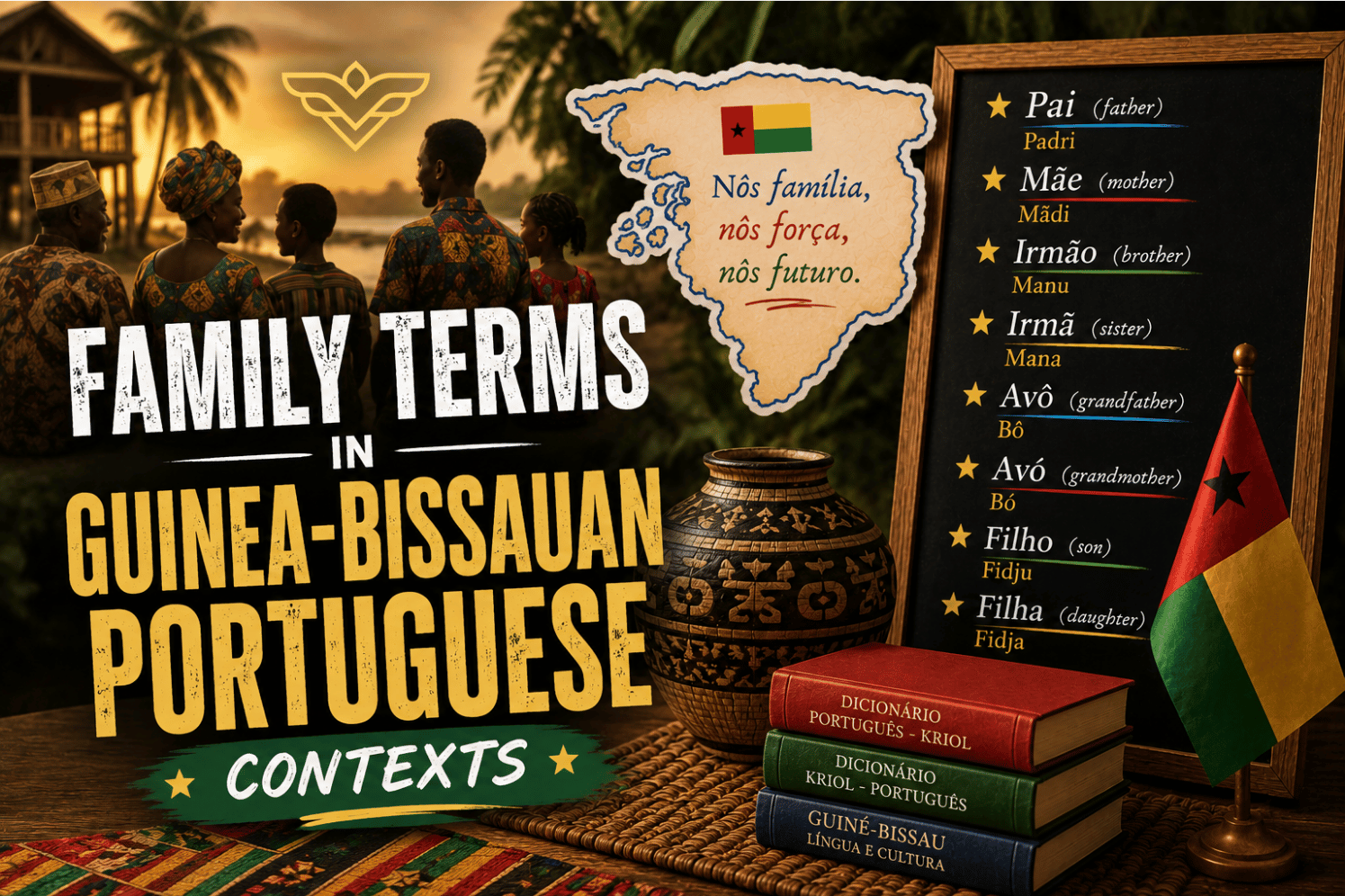
Pai (father)
Mãe (mother)
Irmão (brother)
Irmã (sister)
Filho / Filha (son / daughter)
Tio / Tia (uncle / aunt)
Avô / Avó (grandfather / grandmother)
Primo / Prima (cousin)
Sogro / Sogra (father-in-law / mother-in-law)
These terms appear in formal settings, education, and mixed conversations. In practice, their meaning often expands to include a wider circle of relatives.
Kriol and Everyday Family Language
In Kriol, family vocabulary is more flexible and widely used:
Pape (father)
Mame (mother)
Ermon or Ermon-matcu (brother)
Ermon-femia (sister)
Fidju (child / son or daughter)
Tiu / Tia (uncle / aunt)
Netu / Neta (grandson / granddaughter)
Primu (cousin)
People often add words like “matcu” (male) or “femia” (female) to clarify. Older or younger siblings may be distinguished as “ermon-garandi” (older brother) and “ermonsinhu” (younger brother). These distinctions reflect the importance of age and hierarchy within the family.
Extended Family Structures Across the Country
Most ethnic groups in Guinea-Bissau organize around large kinship groups or lineages. Households often include multiple generations, uncles, aunts, cousins, and foster children living under one roof or in nearby compounds.
Responsibility for children, land, and support frequently extends beyond biological parents. Uncles and aunts play active roles in education and decision-making. In many communities, inheritance and land rights follow specific rules tied to lineage rather than the nuclear family alone.
This extended model provides strong social safety nets and reinforces collective identity.
Bijagó Cultural Influences: Matrilineal Traditions
The Bijagó people of the Bijagós Archipelago offer a distinctive perspective. Their society is largely matrilineal. Clan membership, land rights, and certain responsibilities pass through the mother’s line.
In Bijagó culture, the maternal uncle often holds special importance as a guide and protector. Women traditionally play strong roles in choosing partners, managing households, and spiritual life. Children belong to their mother’s clan, which influences access to resources and social standing.
While practices vary across islands and have evolved over time, these matrilineal elements continue to shape family life and stand out within Guinea-Bissau’s broader cultural landscape.
Practical Phrases for Conversations
Use these simple expressions to talk about family:
Este é o meu irmão. This is my brother.
Tenho uma família grande. I have a big family.
O meu tio mora perto. My uncle lives nearby.
Como está a sua mãe? How is your mother?
Somos todos parentes. We are all relatives.
In Kriol-influenced speech, you might hear warmer, more inclusive versions that reflect everyday closeness.
FAQs
What does “irmão” mean in Guinea-Bissau?
It can mean a biological brother, a close male relative, or even a trusted friend or community member, reflecting the broad sense of kinship.
How is family different in Guinea-Bissau compared to Europe?
Extended families play a larger role. Support, housing, and responsibilities often involve uncles, aunts, cousins, and lineage groups.
What is special about Bijagó family structures?
Bijagó society is largely matrilineal. Clan membership and certain rights pass through the mother’s side, and maternal uncles hold important roles.
Do people use Portuguese or Kriol for family terms?
Both. Portuguese appears in formal contexts, while Kriol dominates daily conversation and feels more natural for most speakers.
Why should language learners study these terms?
They open the door to understanding social relationships, showing cultural respect, and connecting more deeply with Guinean communities.
Are family structures the same across all ethnic groups?
No. Practices vary. Some groups emphasize patrilineal lines, while others, like the Bijagó, highlight maternal connections.
Final Thoughts
Family terms in Guinea-Bissau reveal a rich web of relationships that go far beyond simple labels. Words like “irmão” carry layers of meaning shaped by extended kinship and, in the Bijagós, by matrilineal traditions. Understanding these terms helps you appreciate the strength of Guinean social bonds and communicate with greater cultural awareness.
You now have practical vocabulary and context to talk about family with respect and insight. This knowledge connects language learning to real human connections.
Ready to explore more Guinea-Bissauan language, culture, and identity? Join NKENNE for immersive lessons that bring these stories and words to life. Let’s keep learning together.