
By: Yvonne Mag-usara
You might know selam by ear long before you recognize ሰላም on a screen. The greeting is familiar. What changes when you learn to read it is that you can recognize it in someone else’s handwriting, send it yourself, or help a younger cousin sound it out.
Fidel (ፊደል) is the writing system that gives Amharic those familiar shapes. Its history reaches back to Ge’ez manuscripts, but it also belongs to the schoolroom, the newspaper, and the family message. Each gives us a different way to see how people pass on the skill of reading.
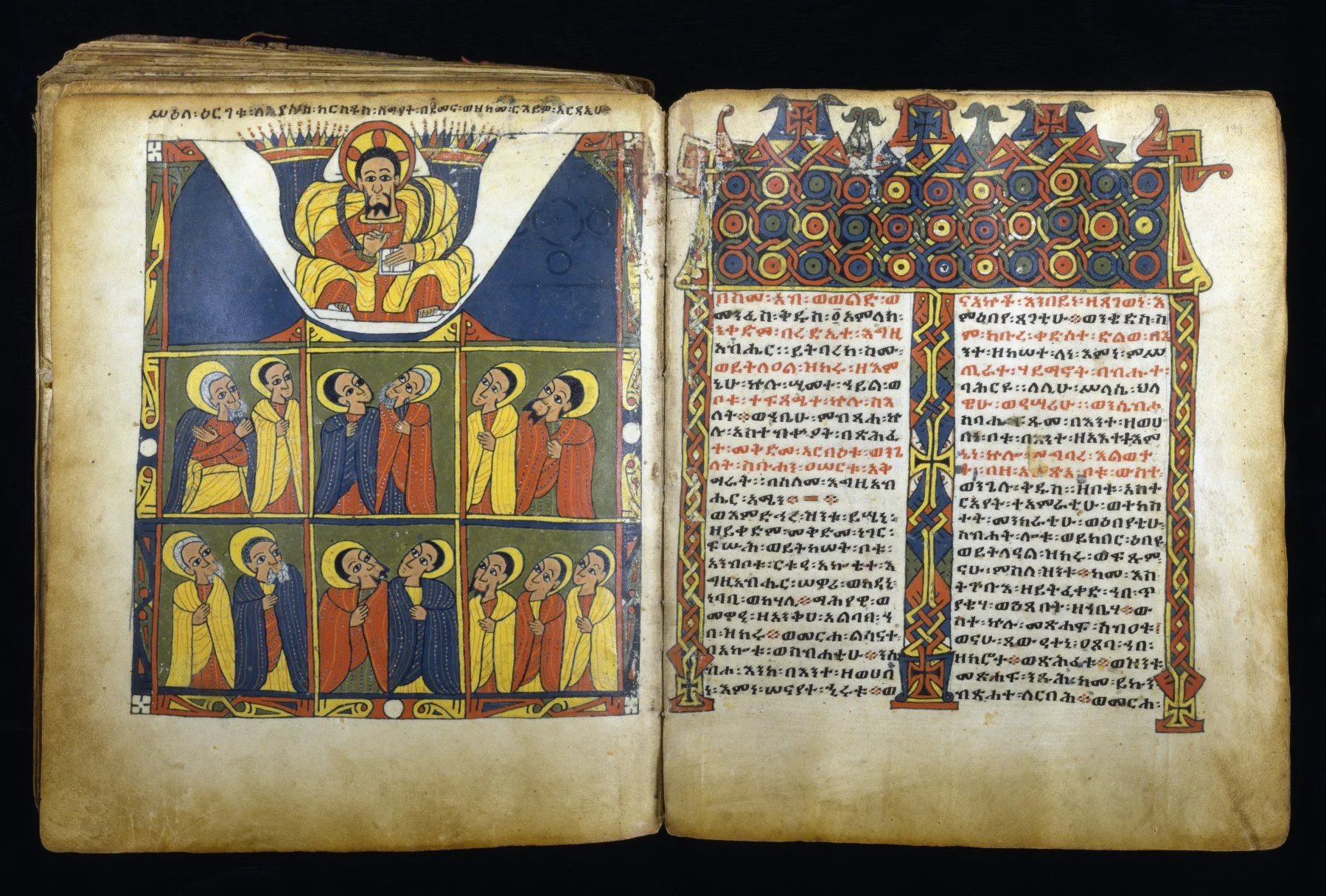
Credit: The Walters Art Museum, MS W.850, fols. 198v–199r, public domain.
A painted Ascension scene faces two columns of Ge’ez in the Gunda Gunde Gospels. The manuscript shows the Ethiopic script that Amharic readers still use today.
What Is Fidel, and How Does It Work?
Fidel is the name commonly used for the Ethiopic writing system as used in Amharic. The word ፊደል can also refer to an individual character. You’ll often see it called the Amharic alphabet, but linguists describe it more precisely as an abugida: a consonant has a basic shape, and changes to that shape usually tell you which vowel goes with it.
Look at the ለ family: ለ ሉ ሊ ላ ሌ ል ሎ. The forms carry the same l sound. The changes tell you whether to read a form such as ሉ (lu), ላ (la), or ሎ (lo). The sixth form, ል, can represent l without a following vowel, depending on the word. These seven forms are traditionally called orders.
This is why a chart becomes easier to use once you see the families. You can compare related shapes instead of trying to memorize every character as if it had nothing to do with the next.
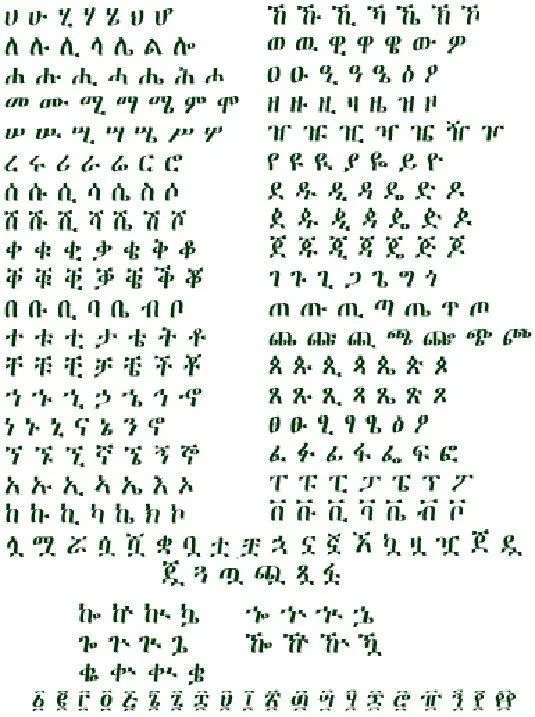
Credit: Abel Gebremariam / Wikimedia Commons, CC BY-SA 4.0.
Read across a row to see how a consonant’s written shape changes with the vowel.
From Ge’ez Manuscripts to the Amharic Newspaper
The Ethiopic script developed for writing Ge’ez, a classical language that remains in liturgical use in the Ethiopian Orthodox Tewahedo Church. Amharic and Tigrinya also use the script. Familiar forms on an old manuscript can therefore tell you something about its writing system without telling you which language the text is in.
In Ethiopian manuscript traditions, scribes used the page to guide the reader’s eye. A nineteenth-century prayer book made by Wäldä Maryam, for instance, uses black ink for the main text and red for names, headings, and some punctuation. The writing is in Ge’ez. The colors help the reader see how the page is organized before reading a word.
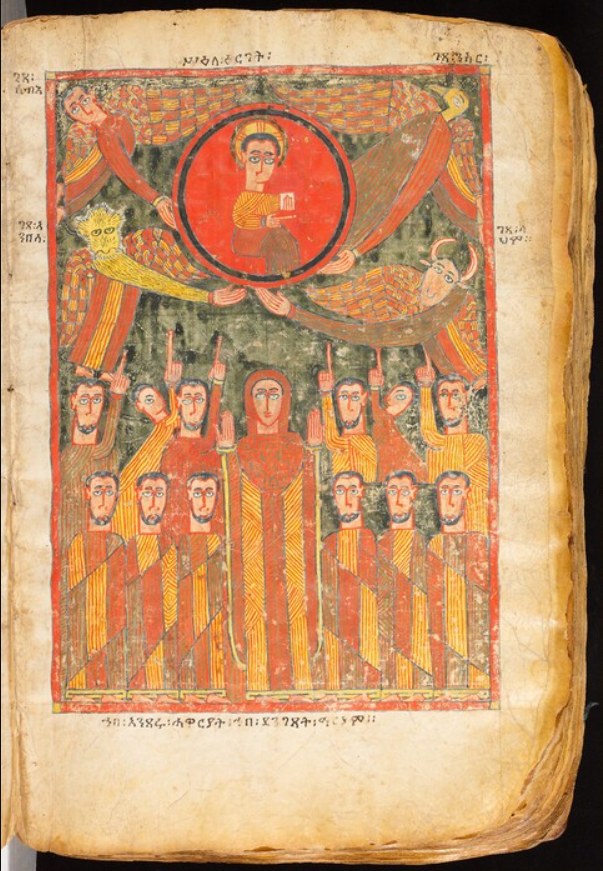
Credit: The Metropolitan Museum of Art, Rogers Fund, 1998 (1998.66), CC0.
Ge’ez writing in an Ethiopian Gospel manuscript shows the older literary tradition from which Amharic inherited the Ethiopic script.
Written Amharic developed alongside that tradition. During Menelik II’s reign, printing helped widen its use, and it became more prominent in court records and the press. Aimro, an early Amharic newspaper, began as a handwritten publication. That detail is easy to miss: readers were already getting news in Amharic before this paper could rely on a printing press.
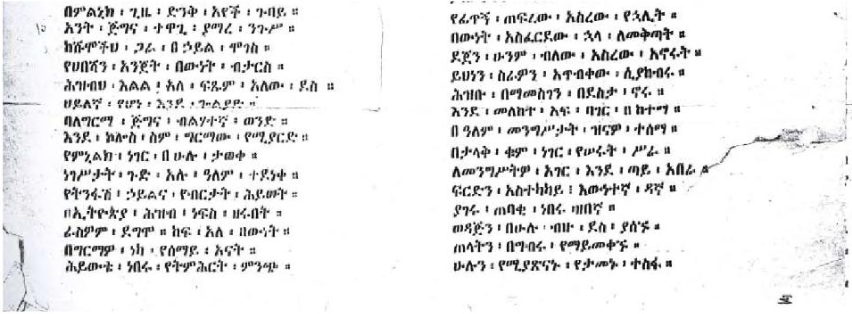
Credit: Aimro, 1924; reproduction by Turtlewong / Wikimedia Commons, CC BY-SA 4.0.
A poem praising Emperor Menelik II appeared in Aimro in 1924, an example of Amharic verse circulating through the press.
How Readers Learn Fidel Across Generations
In traditional Ethiopian Orthodox reading schools, a teacher or monitor could guide a learner along a Fidel chart, pointing to each character as the learner said it aloud. Once the learner knew the sequence, the teacher could change the order. That made it possible to tell whether the child recognized a character on sight or remembered what came next in the row.
That is one tradition of teaching Fidel. Research on early literacy also describes classroom approaches that bring common words into the lesson or group characters by visual similarities. Saying the forms aloud helps learners practice the sound and the shape together. Finding those same forms inside a word gives the practice a purpose.
You can try that distinction at home. Ask someone who reads Amharic to write one familiar word and say it slowly. Copy it once, then see if you can find one of its characters somewhere else. A label, a book title, or a relative’s message gives you a better test of recognition than a row you already know by heart.
How to Start Reading and Writing Fidel Today
Start with ሰላም, commonly written as selam in Latin letters. It means “peace” and is used to say hello. Read it from left to right: ሰ gives the opening s sound with a vowel, ላ is la, and ም closes the word with m. Three written characters make a greeting you may already know by ear.
Try writing it by hand first. Then use an Amharic keyboard to type ሰላም and send it to someone you would normally greet with selam. Some keyboards let you type a consonant and vowel using Latin keys and then produce the corresponding Fidel character. You can keep the sound you already know while getting used to the written form.
For your next word, pick one you’ll actually see again. You could start with a greeting from NKENNE’s guide to introducing yourself in Amharic, or look for the Amharic title of a song in our profile of Tilahun Gessesse. A familiar song title gives you something to listen for as you read.
FAQs
Is Fidel the same as the Amharic alphabet?
“Amharic alphabet” is a common name for it. Abugida describes how it works more precisely: a consonant’s written form typically changes to show the vowel that goes with it.
Are Ge’ez and Amharic the same language?
No. They are distinct languages that share the Ethiopic script. Ge’ez is used in liturgy, while Amharic is a living language used in conversation, print, and digital writing.
Why do Fidel charts have seven columns?
Each column shows one of the seven main orders. Reading across a family lets you compare the forms associated with different vowels, including a sixth form that can also represent a consonant without a following vowel.
Is Amharic written from left to right?
Yes. Read the characters in a word such as ሰላም from left to right, beginning with ሰ.
Do I need to memorize the whole chart before reading?
You can start with a few characters and use them in familiar words. Early literacy instruction can pair basic Fidel forms with words learners already know, giving them a way to practice recognizing characters in context.
Conclusion
A handwritten word can tell you something a typed one cannot: how a particular person made those letters. If you have an old photo with a name on the back or a note tucked into a book, ask someone to read it with you. There may be a story behind the handwriting that nobody has thought to tell you yet.
And once you can write a word yourself, you get to leave something for the next reader. A name under a photo or a greeting in a message is enough to begin.
Learn Amharic Through Culture With NKENNE
With NKENNE, you can build your Amharic through everyday words and expressions. Take one phrase from a lesson, find it in Fidel, and use it with someone you know. The next time it comes back to you in a message, see how much you can read on your own.


