
By: Chimdindu Ken-Anaukwu
You meet someone new and the conversation moves past greetings. They ask about your family. You want to describe a friend. Or someone asks what you do for work. These everyday topics keep conversations flowing and help you build real connections.
In Swahili, talking about people, family, and jobs is simple once you know a few key words. In this post, you will learn essential family terms like Baba, Mama, Kaka, and Dada. You will also master how to ask about someone’s job with “Kazi yako ni nini?” and describe people using words like Mrefu, Mfupi, and Mzuri. These phrases will help you chat naturally about life and work.
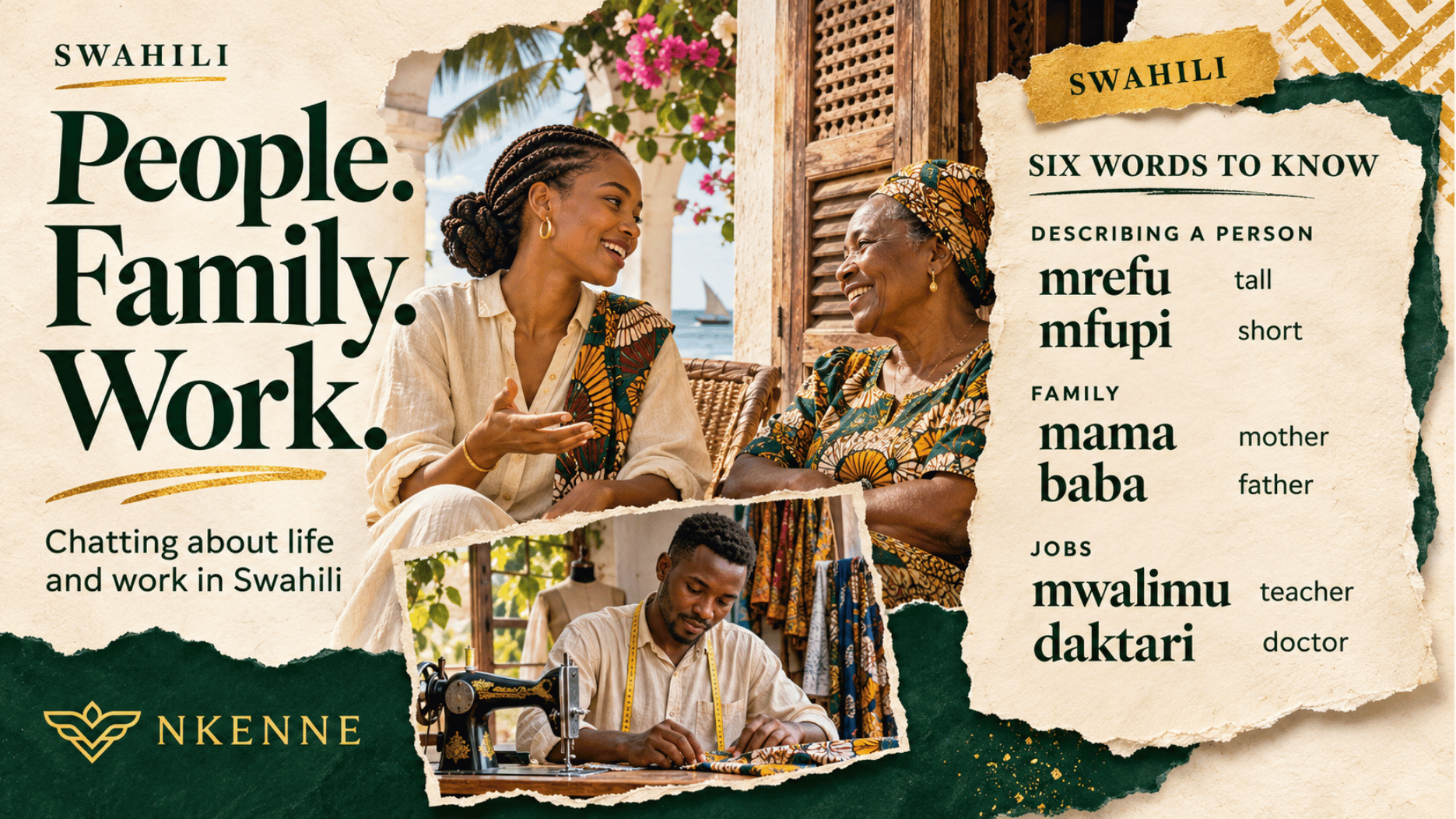
Why Talking About People and Work Matters
In Swahili-speaking communities, asking about family and work shows genuine interest. It is polite and helps build rapport. Whether you are making friends, networking, or simply chatting with neighbours, these topics come up often. Knowing the right words makes you sound more confident and connected.
Essential Family Terms
Start with the closest family members:
Baba – Father
Mama – Mother
Kaka – Brother (older or general)
Dada – Sister
Other useful terms:
Ndugu – Relative or sibling (can also mean brother/sister in a broader sense)
Mwana – Child / son
Binti – Daughter
Mke – Wife
Mume – Husband
Familia – Family
Examples:
Baba yangu anaitwa John. (My father’s name is John.)
Nina kaka wawili na dada mmoja. (I have two brothers and one sister.)
Mama yangu ni mwalimu. (My mother is a teacher.)
Asking About Jobs
The most common and natural question is:
Kazi yako ni nini?
Pronunciation: KAH-zee YAH-koh nee NEE-nee?
Meaning: What is your job? / What do you do for work?
You can also say:
Unafanya kazi gani? (What kind of work do you do?)
Unafanya nini? (What do you do?)
Common job words:
Mwalimu – Teacher
Daktari – Doctor
Mfanyabiashara – Business person
Mwanafunzi – Student
Mkulima – Farmer
Dereva – Driver
Muuguzi – Nurse
Example replies:
Kazi yangu ni mwalimu. (My job is teaching / I am a teacher.)
Mimi ni daktari. (I am a doctor.)
Ninafanya biashara. (I do business.)
Simple Ways to Describe People
Use these basic adjectives to talk about appearance or character:
Mrefu – Tall
Mfupi – Short
Mzuri – Good / nice / beautiful
Mzito – Heavy / serious
Mwembamba – Slim / thin
Mkubwa – Big / large / important
Mdogo – Small / young
Examples:
Kaka yangu ni mrefu. (My brother is tall.)
Dada yangu ni mzuri. (My sister is beautiful / nice.)
Yeye ni mfupi kidogo. (He/she is a bit short.)
Rafiki yangu ni mtu mzuri. (My friend is a good person.)
You can combine them:
Baba yangu ni mrefu na mzito. (My father is tall and heavy-set.)
Putting It All Together in Conversation
A simple flow often looks like this:
Ask about family.
Share a bit about your own.
Ask about work.
Add a short description if it fits naturally.
This keeps the chat balanced and friendly.
Useful Follow-Up Questions
Una ndugu wangapi? (How many siblings do you have?)
Wanaishi wapi? (Where do they live?)
Kazi yake ni nini? (What is his/her job?)
Ana umri gani? (How old is he/she?)
Unapenda kazi yako? (Do you like your job?)
Full Example Conversations
Casual version:
You: Habari! Una familia kubwa?
Person: Ndiyo. Nina kaka wawili na dada mmoja.
You: Vizuri. Kazi yako ni nini?
Person: Mimi ni mwalimu.
You: Sawa. Kaka yako ni mrefu?
Person: Ndiyo, ni mrefu sana.
Slightly deeper version:
You: Mama yako anafanya kazi gani?
Person: Mama yangu ni muuguzi.
You: Ah, kazi nzuri. Na wewe?
Person: Mimi ni mfanyabiashara.
You: Familia yako ni wazuri. Nimefurahi kukutana nawe.
Quick Tips for Natural Chats
Start with family before diving into personal details. It feels warmer.
Use “yangu” (my) and “yako” (your) correctly to keep things clear.
Smile and keep descriptions positive when meeting someone new.
Listen carefully and ask one follow-up question. It shows interest.
Practice saying the family terms out loud until they feel natural.
FAQs About Describing People and Jobs in Swahili
What is the difference between Kaka and Ndugu?
Kaka usually means brother. Ndugu can mean sibling or relative in a broader sense and is sometimes used more generally.
How do I say “I am a student”?
Say “Mimi ni mwanafunzi” or “Kazi yangu ni kusoma” (My work is studying).
Can I use Mzuri for both people and things?
Yes. Mzuri works for people (nice, good-looking) and for things (good, beautiful).
Is it polite to ask about someone’s job right away?
Yes, after basic greetings. “Kazi yako ni nini?” is a common and accepted question.
How do I describe someone who is young?
You can say “mdogo” (small/young) or “bado kijana” (still a young person).
Do these phrases work in both Kenya and Tanzania?
Yes. They are standard across Swahili-speaking East Africa.
conclusion
Talking about family, work, and simple descriptions opens the door to longer and more meaningful conversations. These words help you move beyond greetings and start building real relationships in Swahili.
Ready to practise more everyday Swahili that helps you connect with people? NKENNE offers practical lessons on family, work, and real-life conversations. Start today and chat with more confidence. Karibu!