
Mastering Wolof Pronunciations: Alphabet, Tricky Consonants, and Sounds for English Speakers
By: Chimdindu Ken-Anaukwu
English speakers often dive into Wolof expecting familiar Latin letters to behave like in English, only to trip over sounds that twist the tongue in new ways. This guide walks you through the Wolof alphabet, highlights unique consonants like ñ, ŋ, x, and c, explains nasal vowels, and flags common pitfalls so you can pronounce words confidently and connect better in Senegalese conversations.
Wolof Alphabet Basics: The Latin Script Foundation
Wolof uses a Latin-based script, adopted in the 1970s for standardization in Senegal.
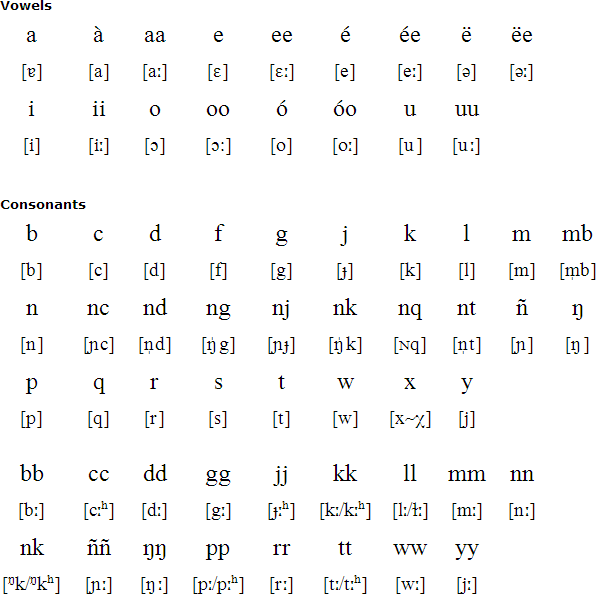
It includes 25 letters: A, B, C, D, E, Ë, F, G, I, J, K, L, M, N, Ñ, Ŋ, O, P, Q, R, S, T, U, W, X, Y.
Missing are H, V, Z, but additions like ñ and ŋ handle unique Wolof sounds.
Vowels come in short and long forms, marked by doubling (aa for long a).
This script evolved from earlier Arabic influences during Islam's spread, but Latin fits modern education and global use.
In practice, it's phonetic: letters mostly match sounds consistently, unlike English.
Here are visual aids for the Wolof alphabet to see the letters clearly.
These charts show standard Wolof orthography, helping you reference as you practice.
Unique Wolof Consonants: Mastering Ñ, Ŋ, X, C, and Others
Wolof consonants include familiar ones with twists and specials that define its rhythm.
Ñ (ñ) sounds like "ny" in "canyon" – try "ñaan" (nyahn, meaning "salt").
Ŋ (ŋ) is the "ng" in "sing" – as in "ŋunj" (ngoonj, a type of fish).
X (x) mimics the "ch" in Scottish "loch" or German "Bach," a throaty scrape – example: "xale" (kha-leh, "child").
C (c) is "ch" in "church" – like "caabi" (cha-bee, "key").
Others: Q (q) is a guttural "k" from the throat, like Arabic "qaf" – "qalam" (qah-lahm, "pen").
R rolls like Spanish "rr."
Gemination (doubling consonants) lengthens sounds, changing meaning – "fan" (where) vs. "fann" (day).
Historically, these reflect Wolof's Niger-Congo roots, blending with Arabic loans from Islam.
Today, mastering them helps in urban Dakar slang or rural chats.
Nasal Vowels in Wolof: Adding Depth to Your Speech
Nasal vowels in Wolof pass air through the nose, like French "bon."
Key ones: an (like French "pain"), en (as in "vin"), in (French "fin"), on (French "bon"), un (French "brun").
Wolof marks them implicitly – context shows nasality, often before m, n, ŋ.
Example: "man" (mahn, nasal a, meaning "I").
This nasality stems from West African linguistic patterns, enhancing expressiveness.
In modern use, it distinguishes words – ignore it, and "fan" (where) becomes unclear.
Practice by humming to feel the nose vibration.
Common Pitfalls for English Speakers in Wolof Sounds
English speakers often flatten Wolof's vibrancy.
Pitfall 1: Treating c as "k" – say "caabi" as "ka-bee" instead of "cha-bee," and locals might hear a different word.
Pitfall 2: Skipping nasal vowels – "man" sounds like "mahn" in English, but without nose air, it loses authenticity.
Pitfall 3: Softening x or q – English lacks these throaty sounds, so practice gargling lightly.
Pitfall 4: Ignoring gemination – doubling like in "fann" requires a real pause, or meanings shift.
Pitfall 5: Flat r – Wolof r rolls; a lazy "r" like American English muddles words.
These errors trace to English's simpler consonant set, but awareness fixes them fast.
Practical Applications: How Wolof Pronunciation Shows Up in Daily Life
Wolof pronunciation isn't abstract; it powers real interactions.
In greetings: "Nanga def?" (nah-ngah def, with nasal an and ŋ) – botch the sounds, and warmth fades.
At markets: Bargain with "ñaata" (nyah-tah, how much), using ñ correctly to engage.
In music: Youssou N'Dour's lyrics rely on x and nasals for rhythm.
Culturally, clear sounds show respect, tying into teranga (hospitality).
Apply by recording yourself against native clips – small tweaks build big confidence.
This pronunciation guide image reinforces daily examples.

FAQ: Key Questions on Wolof Pronunciation
What is the Wolof alphabet based on?
It's Latin-script with additions like ñ and ŋ for unique sounds, standardized in Senegal for consistency.
How do you pronounce tricky Wolof consonants like ñ and ŋ?
Ñ is "ny" as in canyon; ŋ is "ng" as in sing. Practice with words like ñaan (salt) and ŋunj (fish).
Why are nasal vowels important in Wolof sounds?
They add nasal resonance, distinguishing words and giving Wolof its melodic quality, influenced by regional linguistics.
What are common Wolof pronunciation pitfalls for English speakers?
Mispronouncing c as k, ignoring nasals, or not rolling r – these stem from English habits but improve with targeted practice.
How has Wolof pronunciation evolved in modern Senegalese culture?
Urban slang mixes French, but core sounds like x and q persist in music and daily talk, preserving heritage.
Where can I hear authentic Wolof pronunciation examples?
Listen to Senegalese music, podcasts, or apps; focus on native speakers for rhythm and intonation.
Wrapping Up: Building Confidence in Wolof Heritage
Nailing Wolof pronunciation unlocks more than words – it opens doors to Senegal's communal spirit, where sounds carry history and connection. You've got the tools now to practice these elements, turning potential stumbles into smooth conversations that honor this enduring culture.
Take the next step with NKENNE's Wolof lessons, blending pronunciation drills with cultural stories for real progress. Join today and speak with the confidence of someone who's truly listened.